
Contact Us
How Do I Choose the Right Homeschool Math Curriculum for My Child?
How Do I Choose the Right Homeschool Math Curriculum for My Child?
Understanding Mastery Learning, Spiral Learning, and Curriculum Fit
Table of Contents
Introduction: Why Choosing a Math Curriculum Feels So Overwhelming
There Is No Perfect Curriculum
What Is a Mastery-Based Math Curriculum?
What Is a Spiral Math Curriculum?
Why Do Families Have Such Different Opinions About Curriculum?
What About Students With Learning Challenges?
The Real Question: How Much Repetition Does Your Child Need?
What Do You Do When Your Child Needs More Repetition?
Need Help Sorting Through It All?

Imagine this:
You're sitting at the kitchen table with three curriculum catalogs open.
You have six browser tabs pulled up.
A homeschool Facebook group is filled with recommendations.
A friend at co-op told you that her curriculum completely transformed math for her child.
Another friend said that same curriculum was a disaster.
Someone insists that spiral review is the secret to long-term retention.
Someone else says mastery learning is the only approach that truly works.
The more research you do, the more confused you become.
You start wondering:
How can people have such different experiences with the same curriculum?
How do I know what's best for my child?
What is a mastery approach or spiral math anyway?
At some point, most homeschool parents find themselves asking these very same questions.
Many homeschool parents spend hours researching curriculum and still feel uncertain about which direction to go.
Part of the confusion comes from the fact that families are often using different words to describe different educational philosophies.
Another part comes from something even more important:
Children learn differently.
Parents teach differently.
Homeschool environments differ from one family to the next.
What works beautifully for one student and one homeschooling parent may not work nearly as well for another.
That's why curriculum recommendations can feel so contradictory.
In this article, we'll look at two common approaches to teaching math: mastery learning and spiral learning. We'll discuss the strengths and challenges of each approach, why different students respond differently, and how repetition, review, and retention influence long-term math success.
Most importantly, we'll explore a question that often matters more than the curriculum itself:
How much repetition does your child need
before a skill becomes a strong and lasting memory?
We'll also look at how to think about curriculum fit from both the student's perspective and the parent's perspective.
Because choosing a homeschool math curriculum isn't about finding the curriculum with the loudest fans.
It's about finding a good fit for the unique learner sitting at your kitchen table and the homeschool family gathered around it.
2. Before We Begin: There Is No Perfect Curriculum
Before we talk about mastery learning and spiral learning, I want to share something I wish more homeschool parents understood:
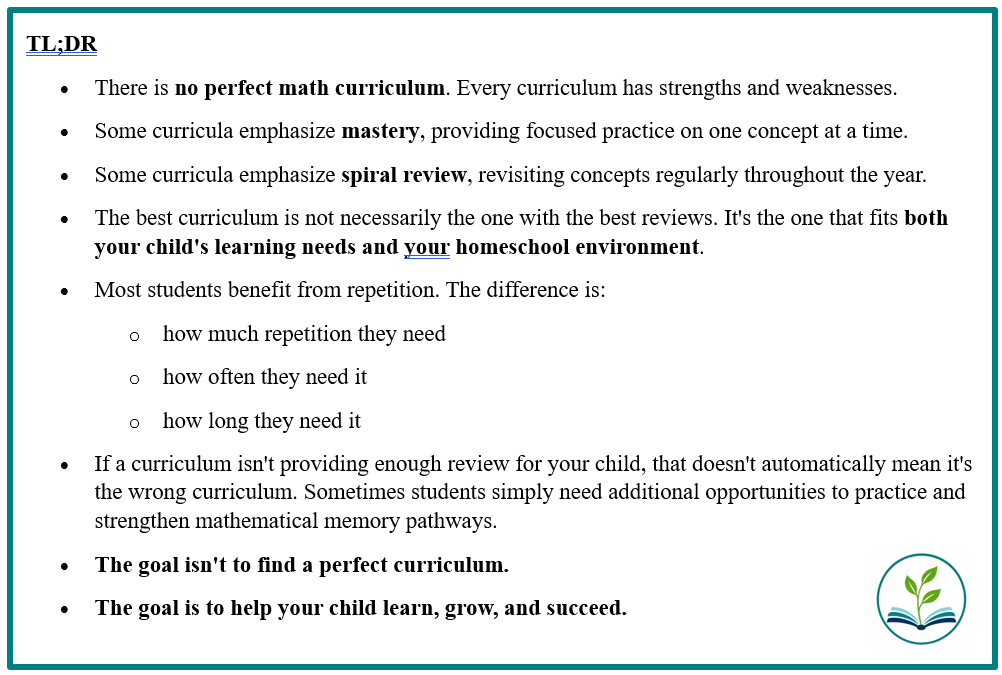
There is no perfect math curriculum.
I know that may sound disappointing, especially if you've spent hours reading reviews, watching curriculum videos, comparing samples, and asking for recommendations in homeschool groups.
But I actually find it reassuring.
After homeschooling since 2008, using a variety of resources with my own children, and tutoring students from many different educational backgrounds, learning challenges, and ability levels, I've learned that every curriculum makes trade-offs.
Some provide lots of focused practice and help students gain confidence with a new skill.
Some provide ongoing review that helps students retain concepts over time.
Some move quickly.
Some move slowly.
Some require significant parent involvement and daily teaching.
Others are designed to encourage greater student independence.
Some work beautifully for one child and become a daily battle for another.
That doesn't necessarily mean the curriculum is good or bad. More often, it means the curriculum's approach doesn't match the needs of that particular student or homeschooling family.
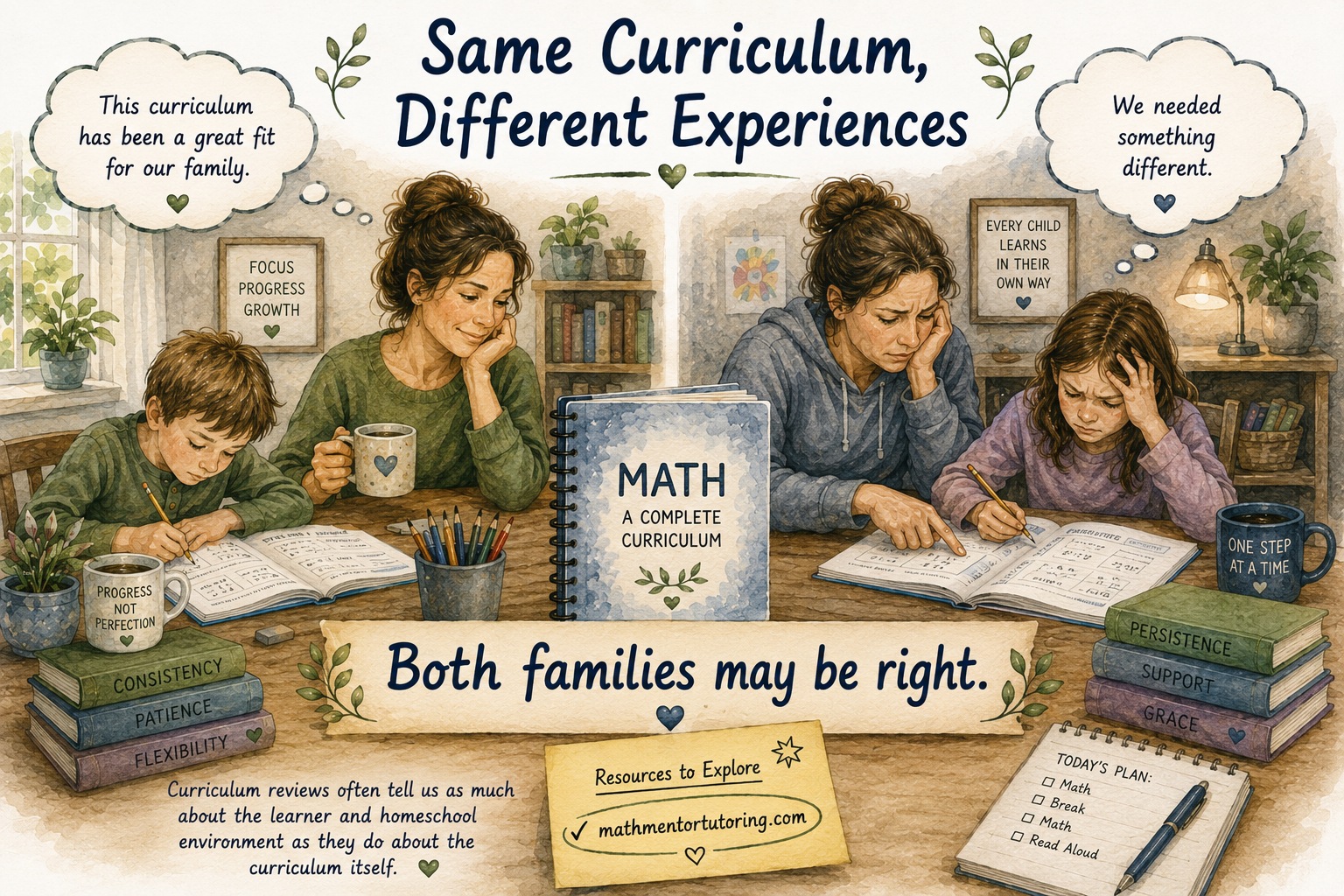
This is one reason homeschool parents can have such different opinions about the very same curriculum.
One family may say, "This curriculum was a game-changer."
Another family may say, "We couldn't wait to switch."
Both experiences can be true.
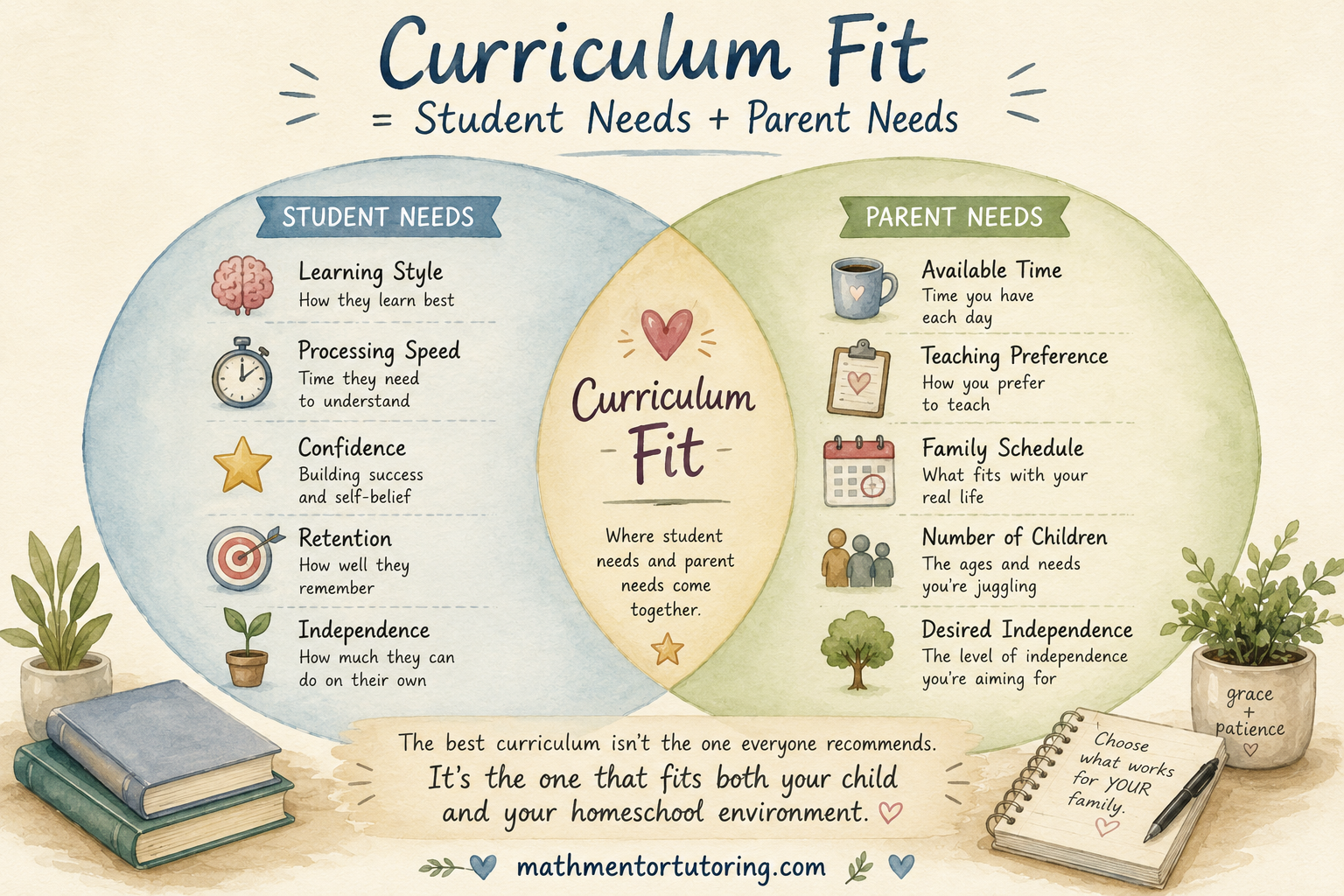
Curriculum decisions need to meet the needs of both the student and the homeschooling parent.
A curriculum that is a wonderful fit for a highly independent learner may not work well for a family that wants a more hands-on teaching experience.
Likewise, a curriculum that requires substantial daily parent involvement may become difficult to sustain for families balancing multiple children, outside work, health challenges, or other responsibilities.
Rather than asking, "Which curriculum is the best?" a more helpful question is:
"Which approach is likely to be the best fit for my child and our homeschool environment right now?"
Understanding the difference between mastery and spiral learning can help answer some of those questions.
3. What Is a Mastery-Based Math Curriculum?
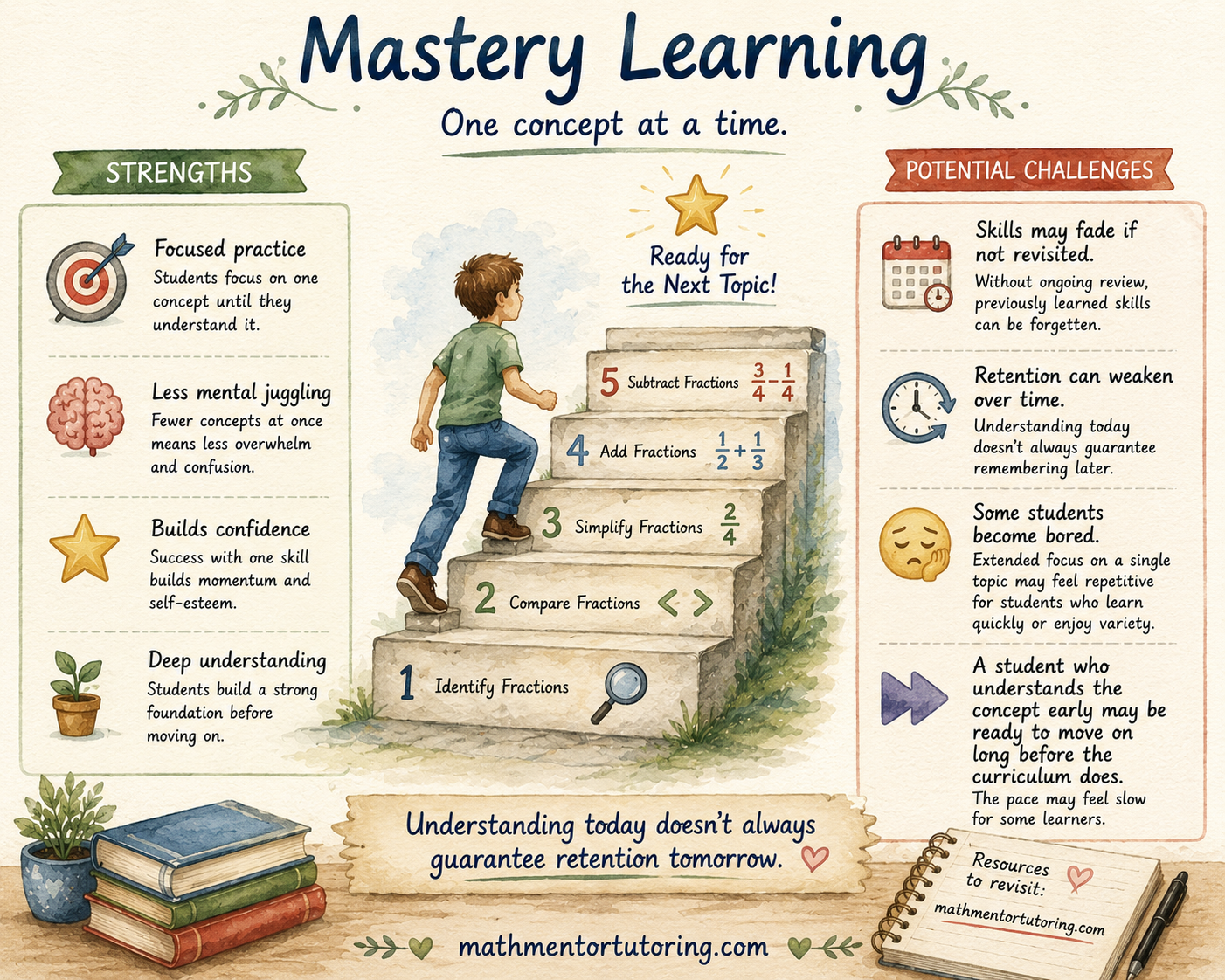
A mastery-based math curriculum focuses on one concept at a time before moving on to the next.
The goal is for students to develop a solid understanding of a skill through focused instruction and practice before introducing something new.
For example, a student might spend several weeks working with fractions. During that time, they may learn to:
reduce fractions
compare fractions
add fractions
subtract fractions
Once those skills are reasonably well understood, the curriculum moves on to a new topic such as geometry, measurement, or decimals.
Many homeschool parents appreciate mastery-based curricula because lessons often feel organized and predictable. Students are not constantly switching gears between different types of problems.
Strengths of a Mastery Approach
A mastery approach can be especially helpful for students who need extra time and repetition when learning a new concept.
Benefits may include:
focused practice on one skill at a time
less mental juggling between multiple concepts
increased confidence as students experience success
deeper understanding of new material before moving forward
For students with slow processing speed or those who become overwhelmed when topics change frequently, a mastery approach can make math feel more manageable.
Potential Challenges of a Mastery Approach
One challenge of mastery learning is long-term retention.
Imagine a student spends three weeks learning fractions, completes the chapter test successfully, and then moves on to geometry. If fractions are not revisited for several months, some of that learning may begin to fade.
In many cases, the issue is not that the student never learned the concept. The issue is that the concept was not revisited often enough for it to become a strong, lasting memory.
What Research Tells Us About Retention
Educational research on retrieval practice and spaced learning suggests that information is more likely to be retained when it is retrieved and reviewed over time. Learning something once is rarely enough. The brain strengthens memory pathways when it has opportunities to revisit and use information repeatedly.
This does not mean mastery learning is ineffective. In fact, mastery can be an excellent way to build understanding and confidence when a concept is first introduced.
However, some students need additional opportunities to encounter and practice that skill later if they are going to remember it months or even years down the road.
https://www.retrievalpractice.org/why-it-works
This idea of ongoing review is one reason many curricula include some form of spiral practice, which we'll look at next.
Research Note: Studies on retrieval practice have consistently found that recalling previously learned information improves long-term retention more effectively than studying it only once (Roediger & Karpicke, 2006).
4. What Is a Spiral Math Curriculum?
A spiral math curriculum takes a different approach.
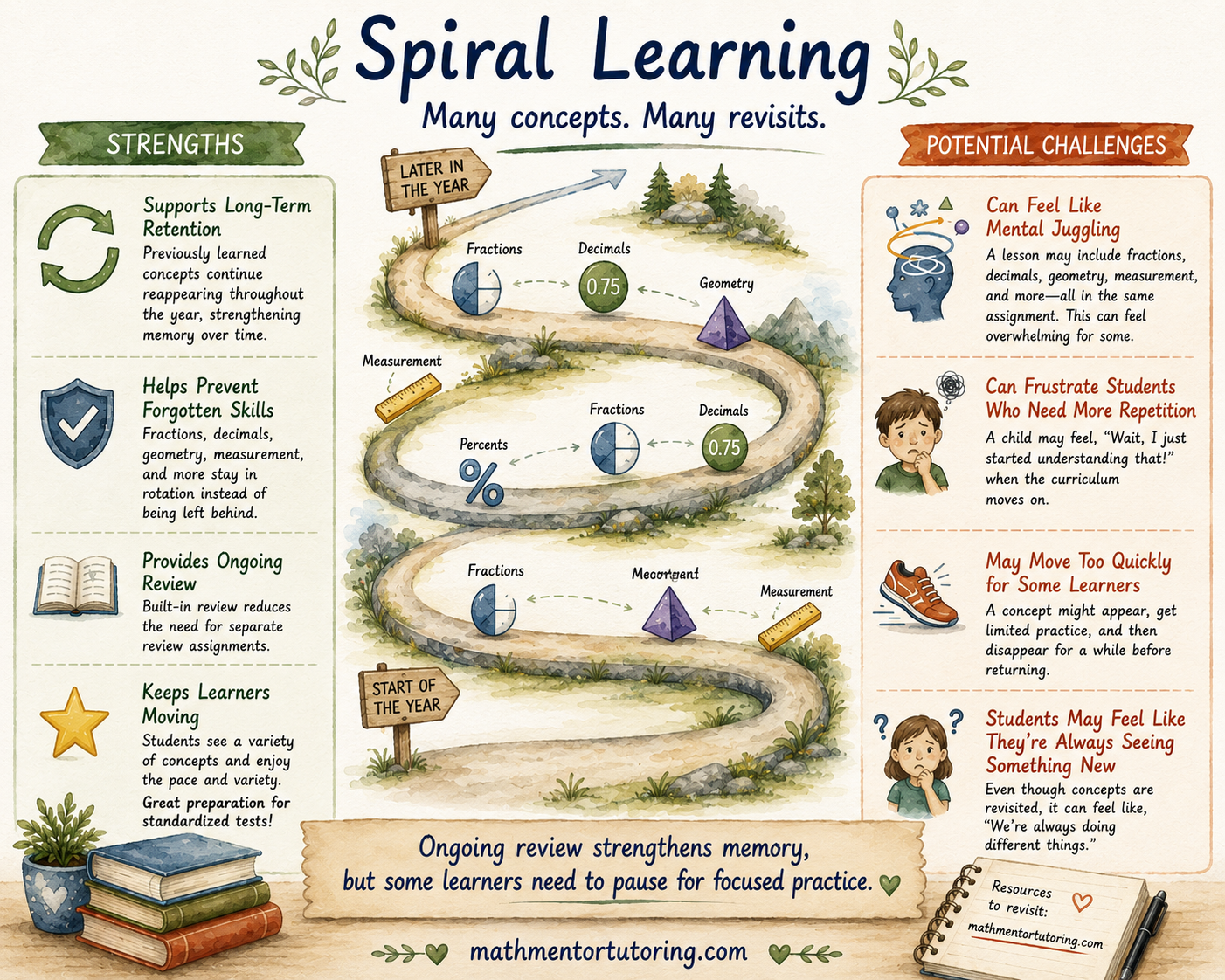
Instead of focusing on one concept for an extended period of time, students continually revisit previously learned skills throughout the year. New concepts are introduced, but older concepts continue to appear in lessons, homework assignments, quizzes, and reviews.
For example, a student may learn fractions in September. In the months that follow, fraction problems continue to appear alongside newer topics such as decimals, geometry, measurement, or percentages.
The goal is not simply to learn a concept once. The goal is to keep important skills active through ongoing review and practice.
Many homeschool parents appreciate spiral curricula because students are regularly reminded of concepts they may have otherwise forgotten.
Strengths of a Spiral Approach
A spiral approach can be especially helpful for students who tend to forget concepts after a chapter ends.
Benefits may include:
ongoing review of previously learned skills
stronger long-term retention
regular opportunities to identify weak areas
increased confidence when students encounter familiar concepts again
less need to "relearn" topics after long periods without practice
Many parents find that spiral review helps keep important skills fresh and prevents the feeling that math concepts disappear as soon as a chapter test is over.
Another benefit of spiral learning is that students become accustomed to shifting between different types of problems. A single assignment may include fractions, geometry, measurement, and decimals.
While some learners find this challenging, it can also help students develop flexibility in their mathematical thinking. This skill becomes especially useful when taking standardized tests, where concepts often appear mixed together rather than grouped neatly by topic.
Potential Challenges of a Spiral Approach
One challenge of spiral learning is that some students need more focused practice before moving on to something new.
Imagine a student who is just beginning to understand fractions. If the curriculum quickly shifts attention to several other topics while only occasionally revisiting fractions, that student may not receive enough practice to feel confident and secure with the new skill.
Some students thrive on variety and frequent review. Others find constant topic switching frustrating or overwhelming.
Parents may hear comments like:
"I just figured this out. Why are we doing something different now?"
or
"I need a little more practice before I'm ready to move on."
For these students, additional focused practice may be necessary before a concept truly sticks.
What Research Tells Us About Learning New Concepts
Educational research suggests that learners can become overwhelmed when too much new information must be processed at the same time. Researchers refer to this as cognitive load. When working memory becomes overloaded, learning can become less efficient.
This does not mean spiral learning is ineffective. In fact, ongoing review is one of the greatest strengths of a spiral approach.
However, some students benefit from spending more time practicing and strengthening a new concept before it is mixed with many other skills.
This helps explain why different students may respond differently to the same curriculum. Some learners thrive with frequent review and variety, while others need additional repetition and focused practice before they feel ready to move forward.
Research Note: Cognitive Load Theory, developed by educational psychologist John Sweller, suggests that learning is most effective when instructional materials are designed to avoid overwhelming a student's working memory.
5. Why Do Families Have Such Different Opinions About Curriculum?
Have you ever noticed that homeschool parents can have completely opposite opinions about the same curriculum?
One parent says:
"This curriculum was a game-changer for us!"
Another says:
"We couldn't wait to switch."
How can both be true?
The answer is that no two homeschooling situations are exactly alike.
Children learn differently.
Some students learn new concepts quickly but need frequent review to retain them.
Some students need substantial repetition before a concept feels secure.
Some students have strong working memory and can keep track of multiple ideas at once.
Others become overwhelmed when too much information is introduced at the same time.
Students also differ in their confidence, prior knowledge, processing speed, attention, and learning challenges. A curriculum that feels clear and manageable for one child may feel frustrating or overwhelming for another.
But there is another piece of the puzzle that often gets overlooked.
Homeschool curriculum decisions must also meet the needs of the homeschooling parent.
Some parents enjoy teaching math and want to be deeply involved in daily instruction. Others are balancing multiple children, outside work, health challenges, caregiving responsibilities, or countless other demands on their time and energy.
Some families thrive with a curriculum that requires daily parent involvement.
Others need a curriculum that allows students to work more independently.
Neither approach is right or wrong.
They are simply different solutions for different families.
Research in education and cognitive science supports what many homeschool parents observe every day: learners vary significantly in how they process, store, and retrieve information. Working memory, executive functioning skills, processing speed, and prior knowledge all influence how easily a student learns and retains new material.
This is one reason curriculum reviews can be so confusing.
When parents share their experiences, they are usually giving an honest account of what happened in their homeschool. But they are also describing a specific child, a specific parent, and a specific season of life.
That's why I encourage parents to read curriculum reviews with curiosity rather than looking for a unanimous winner.
A curriculum that worked beautifully for your friend's child may not be the best fit for yours.
Likewise, a curriculum someone else disliked may be exactly what your family needs.
One of the most helpful things I've learned as both a homeschool parent and math tutor is this:
If we really pay attention, curriculum reviews often tell us as much about the learner and the homeschooling environment as they do about the curriculum itself.
6. What About Students With Learning Challenges?
As we've discussed, children learn differently. Some differences are simply part of a child's natural learning style. Others may be connected to a diagnosed learning challenge.
It's important to remember that not every struggling math student has a learning disability.
Sometimes a student simply needs:
more repetition
more review
more time
more practice
more encouragement
Needing additional support does not mean a child is incapable of learning math.
Dyslexia
Dyslexia is primarily a language-based learning difference that affects reading and language processing.
While dyslexia is not a math disability, it can impact a student's ability to read word problems, remember math vocabulary, follow multi-step directions, and retrieve information quickly.
Many students with dyslexia are strong mathematical thinkers but benefit from additional support with the language demands that often accompany math.
Dyscalculia
Dyscalculia is a math-specific learning disability that affects a person's understanding of numbers and mathematical relationships.
Students with dyscalculia may struggle with number sense, math fact recall, estimation, and recognizing patterns in numbers.
Like dyslexia, dyscalculia exists on a spectrum. Some students experience mild challenges while others require significant support.
Slow Processing Speed
One challenge I encounter frequently in tutoring is slow processing speed.
These students are often capable of understanding the concept. They simply need more time to think through the information, organize their thoughts, and respond.
A student with slow processing speed may:
understand a lesson after additional practice
need more examples before feeling confident
take longer to complete assignments
require more repetition before a skill becomes automatic
Unfortunately, these students are sometimes labeled as "bad at math" when the real issue is that they simply need more time and more opportunities for spaced repetition to strengthen learning.
More Repetition Does Not Mean Less Ability
Needing more repetition is not a sign of lower ability.
Some students build mathematical memory pathways quickly.
Others need concepts revisited many times before those pathways become strong and reliable.
Neither approach is wrong.
This is one reason I often encourage parents to focus on building strong foundations rather than rushing ahead. If you're working with an older student who has gaps in foundational skills, you may find this article helpful:
How to Rebuild Math Foundations for Teens Without Using "Little Kid" Curriculum.
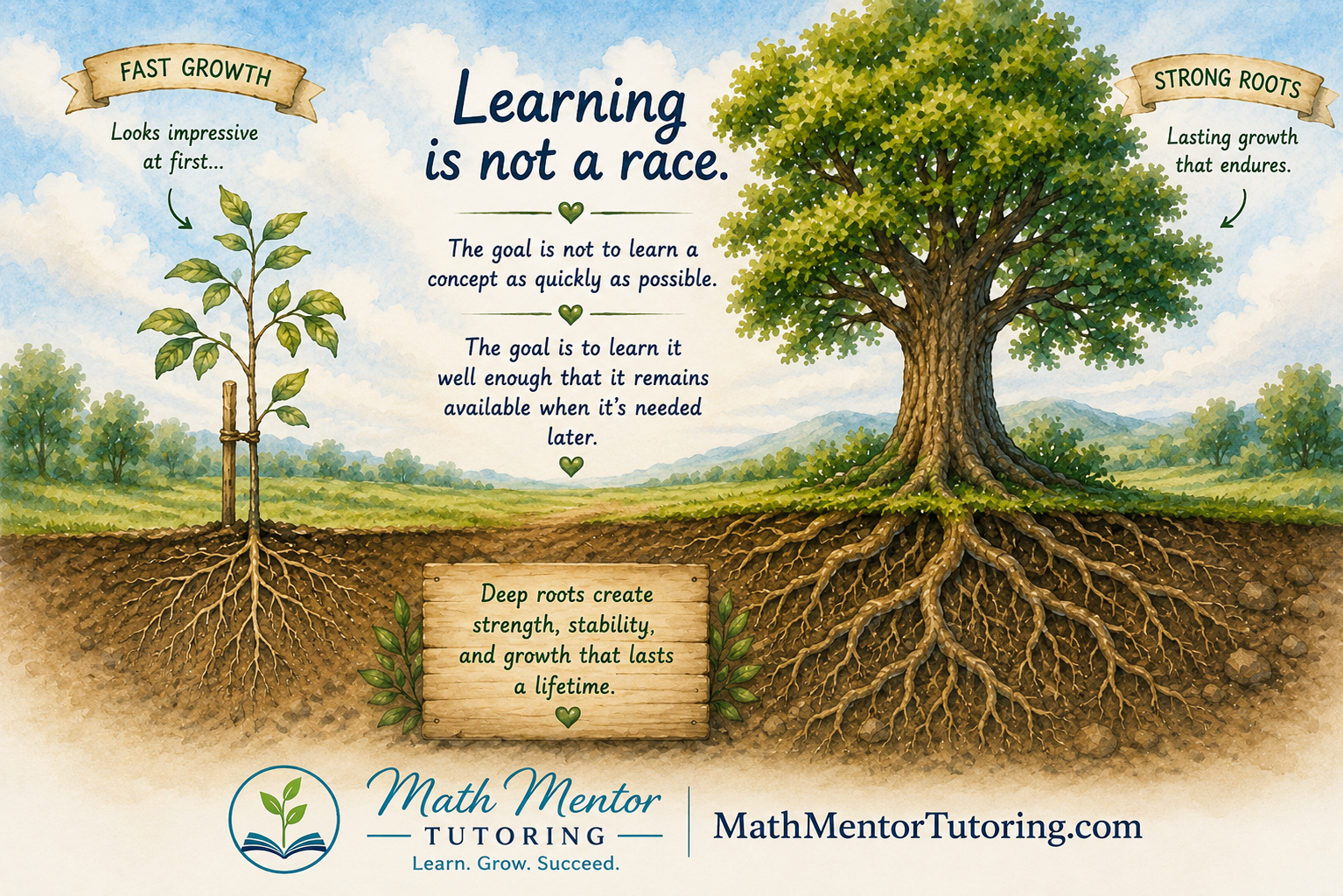
Learning is not a race.
The goal is not to learn a concept as quickly as possible. The goal is to learn it well enough that it remains available when it's needed later.
Understanding how your child learns can help you choose a curriculum that supports their strengths while providing the level of repetition, review, and practice they need to succeed.
7. The Real Question: How Much Repetition Does Your Child Need?
By this point, you may be wondering:
"So which approach is better? Mastery or spiral?"
The longer I work with students, the more I believe the answer depends less on the curriculum and more on the learner.
The real question is not whether your child needs repetition. Everyone does.
The real question is:
How much repetition does your child need
before a skill becomes a strong and lasting memory?
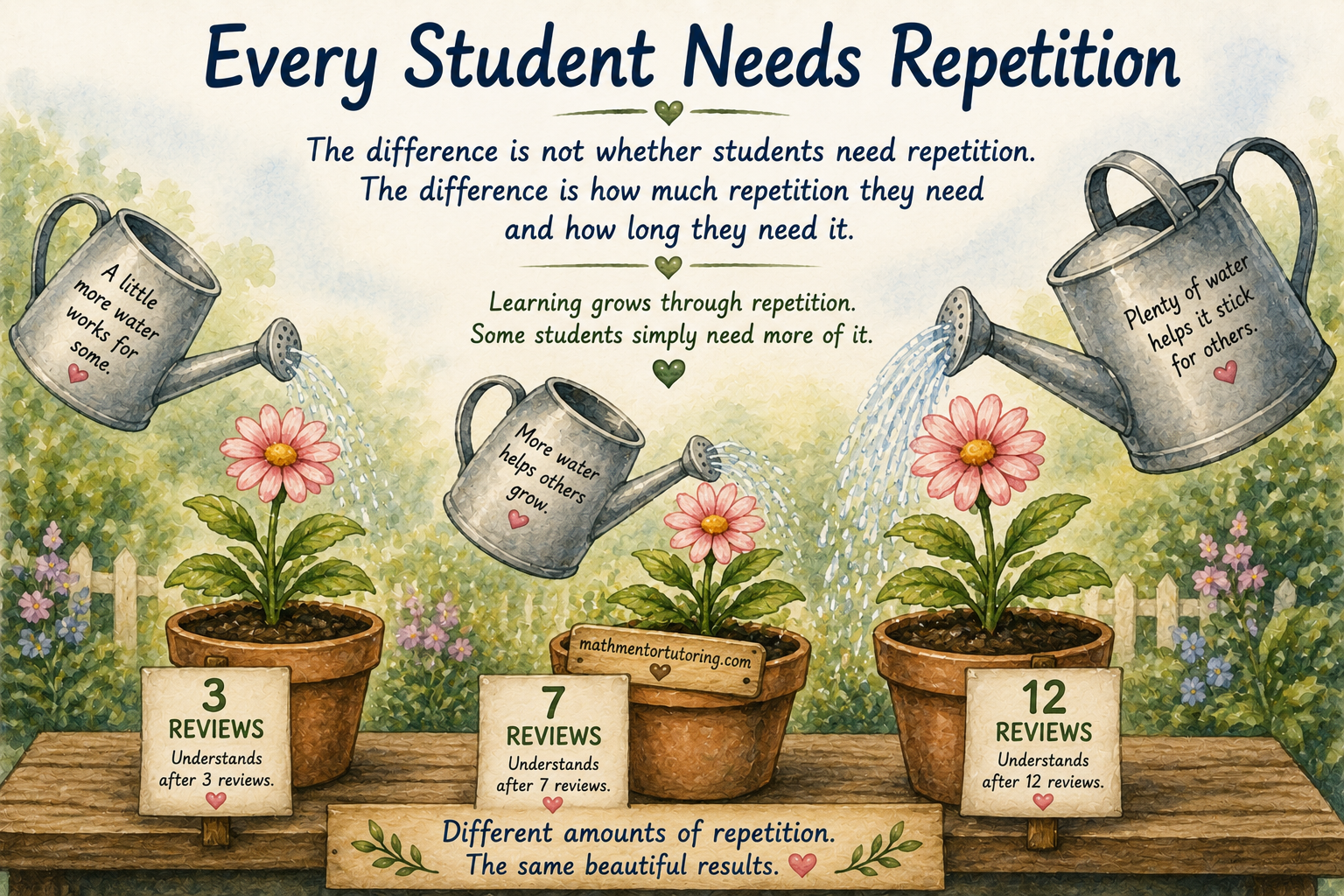
Every Student Benefits From Repetition
·Some students learn a new skill and retain it with only occasional review.
·Others may understand the concept today but need additional opportunities to revisit it tomorrow, next week, next month, and even later in the year before it becomes automatic.
·Neither student is doing anything wrong.
·Both are simply building mathematical understanding at different rates.
This is one reason curriculum recommendations can vary so widely from family to family. A curriculum that provides plenty of review for one student may not provide enough review for another.
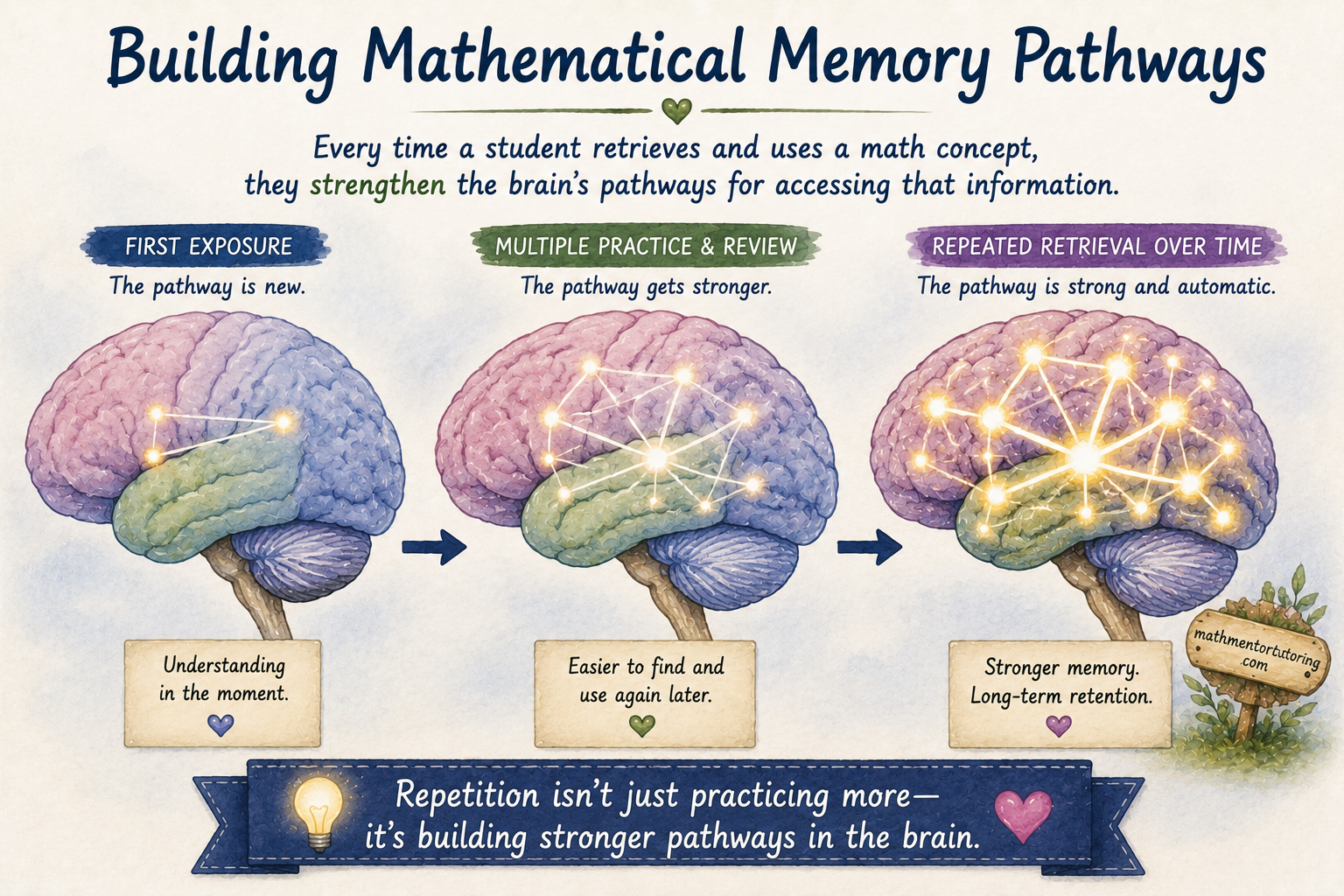
Building Mathematical Memory Pathways
Learning math is about more than understanding a concept in the moment.
Students also need to remember that concept when it appears again weeks, months, or even years later.
Educational research on retrieval practice suggests that memory becomes stronger when students have opportunities to retrieve and use information repeatedly over time. Each successful retrieval helps strengthen the brain's pathways for accessing that information later (Roediger & Karpicke, 2006).
This helps explain why some students seem to remember a skill after only a few exposures while others need many more opportunities to practice and revisit the same concept.
Why This Matters More Than Curriculum Labels
Two students can use the exact same curriculum and have very different experiences.
·One student may receive all the review they need from the curriculum itself.
·Another student may need additional practice or additional review before concepts truly stick.
That doesn't necessarily mean the curriculum is flawed.
It may simply mean that the amount of repetition built into the curriculum doesn't match the amount of repetition that particular student needs.
The Goal Is Not Speed
As homeschool parents, it's easy to become concerned when a child needs more practice, more review, or more time than expected.
But learning is not a race.
The goal is not to learn a skill as quickly as possible.
The goal is to remember it when it is needed later.
A student who requires more repetition is not less capable.
They may simply need additional opportunities to strengthen the memory pathways that support long-term retention.
The Takeaway
The difference is not whether students need repetition.
They all do.
The difference is how much repetition they need, how often they need it, and how long they need it.
Understanding this simple idea can remove much of the frustration from choosing curriculum, evaluating progress, and supporting your child's learning journey.
Instead of asking, "Which curriculum is best?"
A more helpful question might be:
"Does this curriculum provide the amount of repetition my child needs?"
8. What Do You Do When Learning Isn't Sticking?
By this point, you may be wondering:
What happens when you've chosen a curriculum that seems like a good fit, but your child is still struggling?
One thing I've learned from both homeschooling and tutoring is that struggling does not automatically mean you've chosen the wrong curriculum.
Sometimes it does.
Curriculum fit matters. There are situations where a different program is clearly a better match for a student's learning style, pace, level of independence, or a parent's teaching preferences.
But sometimes the issue is something entirely different.
The student simply needs more repetition than the curriculum provides.
This is where many homeschool parents find themselves at a crossroads.
When progress slows down, it's easy to assume the answer is to switch curricula and start over. Sometimes that is the right decision. Other times, the curriculum itself isn't the problem.
The real question becomes:
Does my child need a different curriculum,
or do they need additional support to help learning stick?
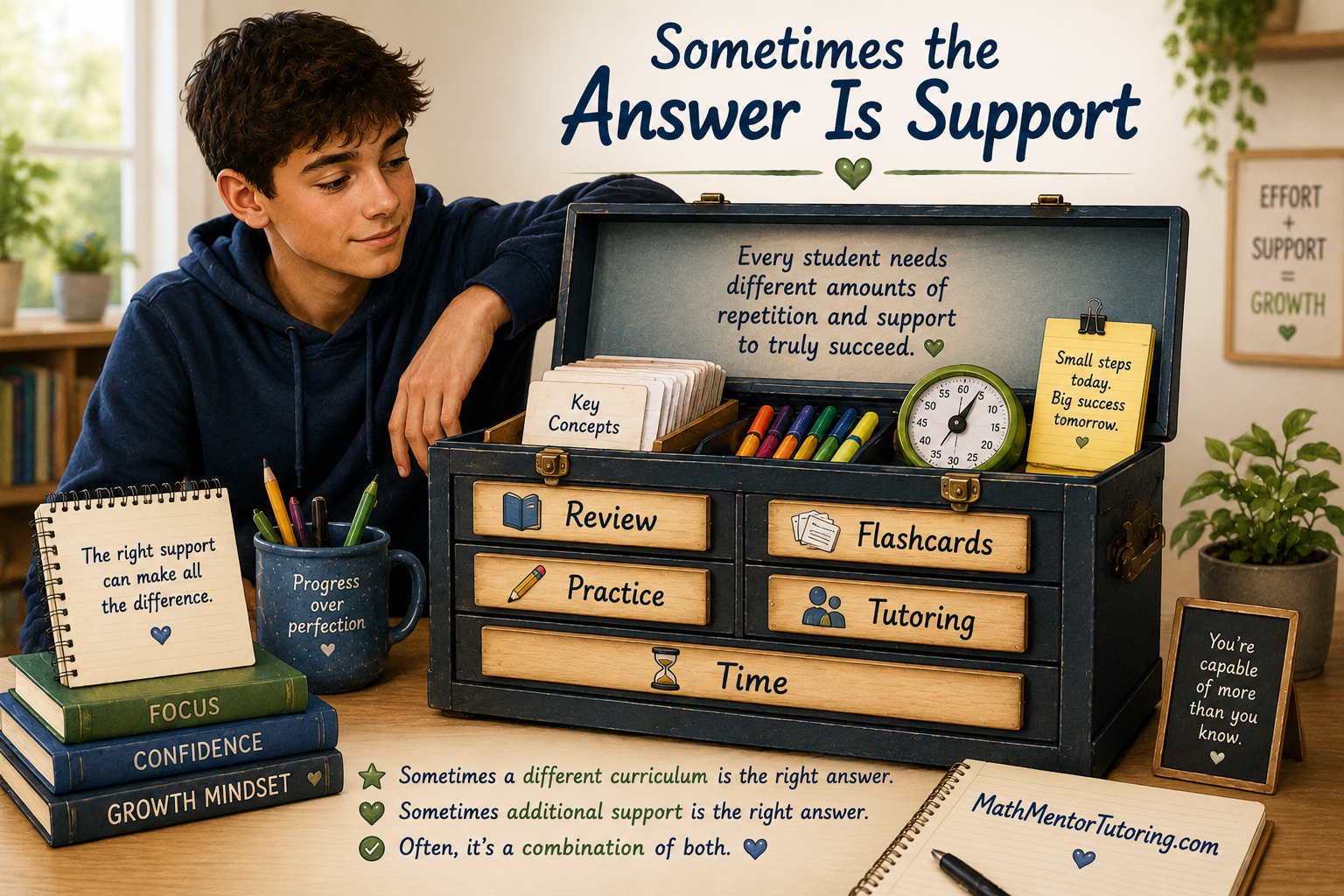
Looking Beyond the Curriculum
Many students benefit from targeted support in specific areas without needing to abandon their current curriculum.
A student may understand fractions but need additional review before fraction operations become automatic.
Another student may be progressing successfully through grade-level material while still needing extra reinforcement of multiplication facts, decimals, or other foundational skills.
In fact, multiplication fact fluency is one of the most common areas where I see older students struggle. If that's a challenge in your homeschool, you may enjoy reading:
What If Your Teen Could Finally Remember Multiplication Facts?
In situations like these, supplemental practice can often provide exactly what the student needs.
That support might come through flashcards, review activities, math games, tutoring, skill-based practice programs, or simply more opportunities to revisit important concepts over time.
The goal is not to force every student through the same amount of repetition.
The goal is to provide each student with the amount of repetition they need.
Supporting Progress While Repairing Gaps
This idea is one reason I believe so strongly in parallel tutoring.
Rather than stopping all grade-level progress to go back and reteach years of material, students continue moving forward while we simultaneously strengthen the foundational skills that may be slowing them down.
In other words, growth doesn't have to stop while gaps are being repaired.
Both can happen at the same time.
When students receive the support they need, they often gain confidence, improve retention, and experience greater success with current coursework as well as future learning.
The Big Takeaway
After all the discussions about mastery learning, spiral learning, repetition, retention, and curriculum fit, I hope you'll remember this:
There is no perfect curriculum.
The best curriculum is not the one with the loudest fans, the highest ratings, or the most enthusiastic recommendations.
The best curriculum is the one that fits your child, fits your homeschool environment, and provides the support needed for long-term success.
Sometimes that means choosing a different curriculum.
Sometimes that means adding additional support.
Often, it's a combination of both.
Final Encouragement
If you're feeling overwhelmed by curriculum decisions, take a deep breath.
You do not have to find the perfect curriculum.
You simply need a curriculum that is a reasonably good fit for your child and your homeschool environment.
For our family, that curriculum was Teaching Textbooks. We used it from 3rd Grade through Pre-Calculus because it provided a combination of instruction, review, independence, and flexibility that worked well for both my children and me as their homeschool teacher.
If you're considering Teaching Textbooks for your homeschool, you can learn more about our experience and explore additional resources here: www.mathmentortutoring.com/teaching-textbooks
Need Help Sorting Through It All?
If you're feeling overwhelmed by curriculum choices, struggling to determine whether your child needs a different approach, or wondering how to support math gaps without starting over, you're not alone.
Sometimes a short conversation with someone who understands both homeschooling and math instruction can bring a lot of clarity.
I offer a free consultation for families who would like to discuss:
curriculum fit
math gaps and foundational skills
mastery vs. spiral approaches
Teaching Textbooks questions
IXL diagnostic results
tutoring support options
Whether you're trying to choose a curriculum, decide whether a change is needed, or simply create a plan for moving forward, I'd be happy to help.
Or learn more about tutoring support at MathMentorTutoring.com.
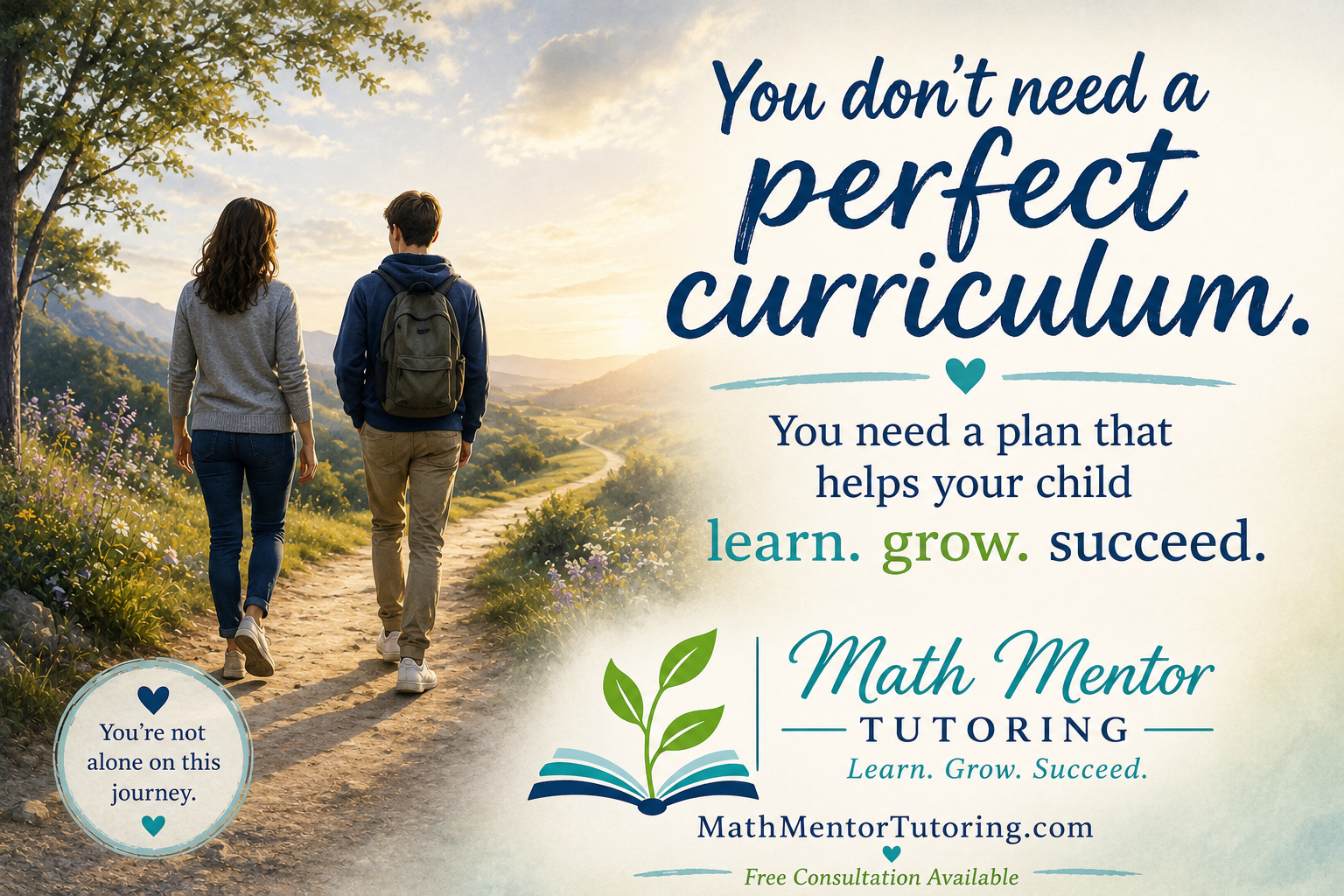
You don't need a perfect curriculum.
You need a plan that helps your child learn, grow, and succeed.
Sources & Further Reading
Parent-Friendly Resources
Working Memory and Learning by Susan Gathercole and Tracy Alloway
A helpful resource for parents and educators who want to better understand why some students need more repetition, more review, or more time to process new information.
Available on Amazon:
https://amzn.to/4xogwOl
Retrieval Practice
Research-based learning strategies grounded in cognitive science that explain how retrieval strengthens memory and improves long-term retention.
https://www.retrievalpractice.org
Harvard Graduate School of Education
Why Students Forget and What You Can Do About It
An accessible article explaining why forgetting is a normal part of learning and how review and retrieval practice can improve retention.
Research Reference
Roediger, H. L., & Karpicke, J. D. (2006).
Test-Enhanced Learning: Taking Memory Tests Improves Long-Term Retention.
Psychological Science, 17(3), 249-255.
Affiliate Disclosure: This article may contain affiliate links. If you make a purchase through these links, I may earn a small commission at no additional cost to you. I only recommend resources I personally use, trust, or believe may be helpful to homeschooling families.
Related Reading
Still exploring curriculum choices, placement decisions, and ways to support long-term math success? These articles may help:
Curriculum & Placement Decisions
• Is Your Child Ready to Start Algebra 1?
• Can Homeschoolers Skip 7th Grade Math? Moving from 6th Grade to Pre-Algebra
• Do Homeschoolers Need to Finish ALL of Algebra 1?
Strengthening Math Foundations
• How to Rebuild Math Foundations for Teens Without Using "Little Kid" Curriculum
• What If Your Teen Could Finally Remember Multiplication Facts?
Practical Homeschool Tools
• What Is a Math Toolkit & Does My Child Need One?

Beth Bowen is the founder of Math Mentor Tutoring, where she works with middle school and high school students, grade 6 through Algebra 1, to build strong mathematical foundations and confident reasoning. A former public high school math teacher and longtime homeschool parent, she brings both classroom experience and personal insight to math placement decisions.
Mrs. Beth specializes in Algebra readiness, strategic sequencing, and targeted foundation repair. She is passionate about reducing test anxiety, equipping students with practical learning tools, and helping families build math confidence that lasts beyond a single course or exam.
She believes that lack of knowledge does not mean lack of intelligence, and that with the right structure and support, students can grow into confident, capable math thinkers.
Mrs. Beth serves families in Baldwin County, surrounding areas, and across the nation via both in person and online tutoring.


