
Contact Us

Do Homeschoolers Need to Finish ALL of Algebra 1
Recently, a homeschool mom asked a simple question in an online group:
“Does everyone complete all of Algebra 1 curriculum or just 80–85% of it?”
The responses were confident and varied.
Some families said they finish every lesson, even if it takes longer than the traditional school year. Algebra 1 is too foundational to cut short.
Others said 80–85% is sufficient. They’ll see it again in Algebra 2.
Both sides care deeply about doing what is right for their students.
But I believe we may be asking the wrong question.
The real issue is not whether you finish 100% of the book.
The real issue is whether the structure of Algebra 1 is truly solid.
Why This Question Feels So Big
Algebra 1 feels like a gatekeeper course.
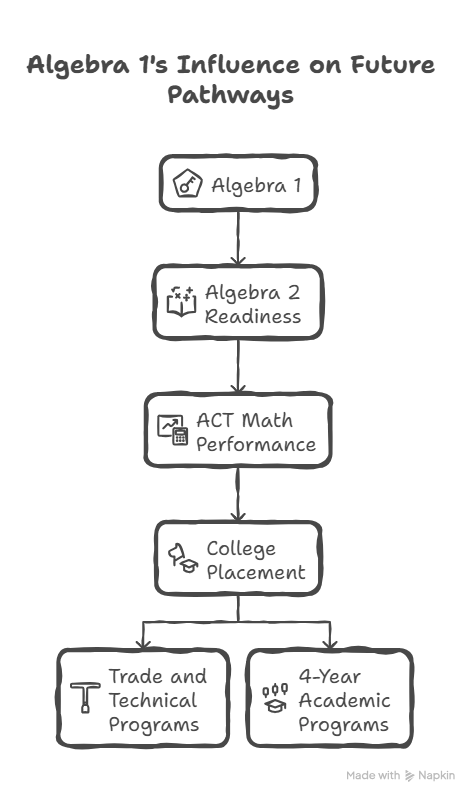
It influences:
Algebra 2 readiness
ACT math performance
College placement
Many trade and technical programs
No parent wants to leave gaps.
At the same time, no parent wants to prolong a year of daily struggle if their child is overwhelmed.
And here is something important that often goes unspoken.
Many times when families ask if 80–85% is “enough,” what they are really saying is:
“This has been hard.”
“My child is struggling.”
“We are tired.”
“Can we stop?”
That deserves compassion.
And it also deserves clarity.
Completion Percentage Is the Wrong Metric
Finishing 100% of a textbook does not automatically mean mastery.
Stopping at 85%... well 85% of what curriculum?
·What is being cut out?
·Is that 85% truly mastered or just pushed through.
Textbooks are not structured equally.
Some final chapters are:
Cumulative review
Enrichment
Optional applications
Early preview of Algebra 2 topics
But some late chapters contain critical structural pieces like:
Factoring
Quadratics
Systems of equations
Inequalities
Radicals
Not all chapters are equal.
So instead of asking:
“Do we finish the book?”
We should be asking:
“Is the structure solid?”

What Must Be Structurally Solid in Algebra 1
If a student moves beyond Algebra 1, these areas need to be secure:
Core Algebra Structure
Solving multi-step equations
Solving and graphing inequalities
Systems of equations
Function notation
Graphing linear equations
Exponential and Polynomial Foundations
Laws of exponents
Operations with polynomials
Factoring
Quadratic equations and their graphs
Geometry Connections
Pythagorean Theorem
Coordinate plane reasoning
Using formulas and solving for variables
Data and Application
Basic probability
Foundational statistics
Algebraic word problems
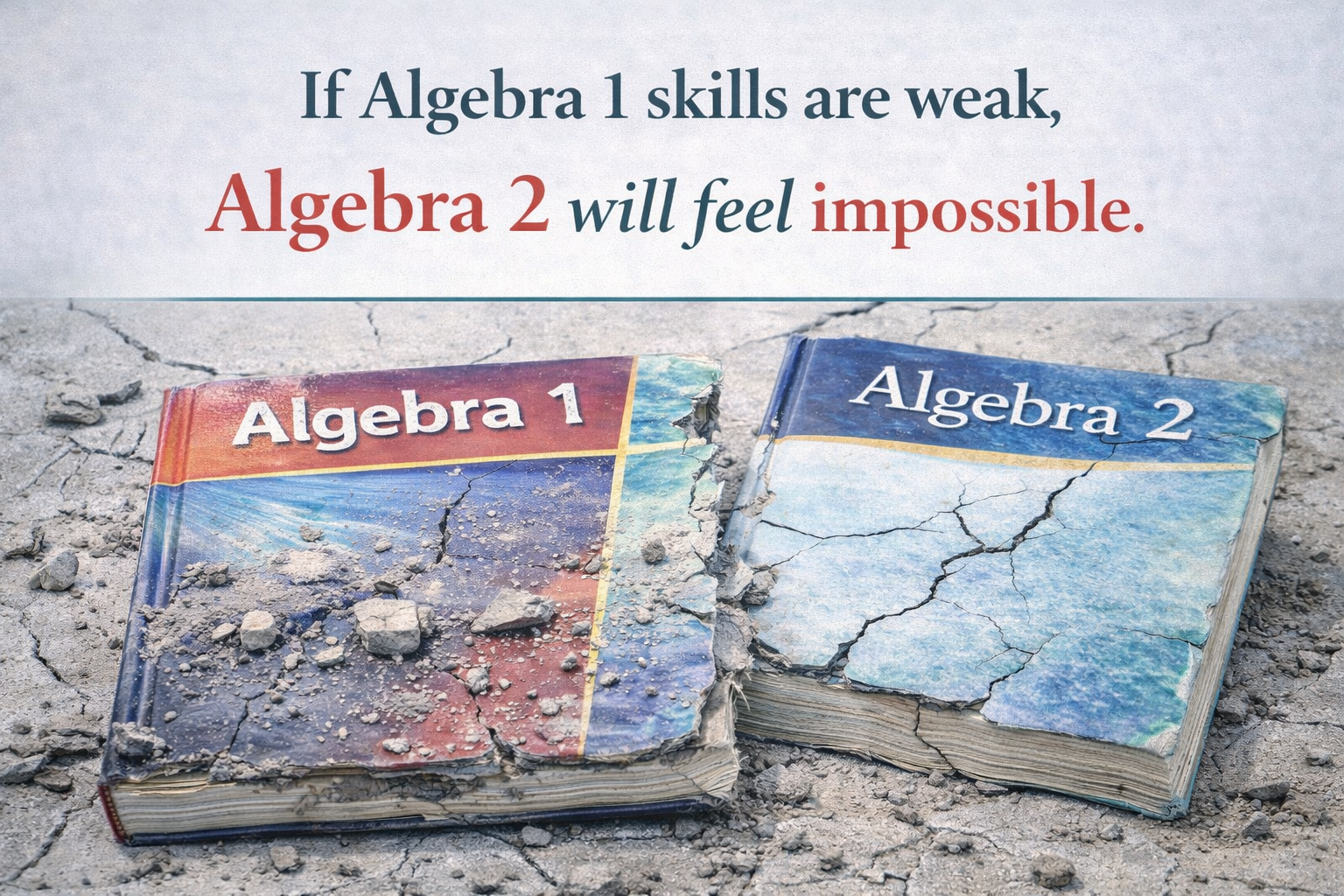
If these are weak, Algebra 2 will not just feel like a step up.
It will feel impossible.
The Hidden Long-Term Sequence Problem
Here is where families sometimes get surprised.
Imagine this path:
Step 1: Weak Algebra 1
The student struggles.
The parent considers stopping at 80–85%.
The foundation is shaky.
Step 2: Geometry
Geometry relies on basic algebra skills. A student who was strong in Pre-Algebra can often do well in Geometry even if Algebra 1 was weak.
But during that year, Algebra 1 skills are not practiced consistently.
If they were weak before, they fade significantly.
Geometry becomes a pause in algebra development.
Step 3: Algebra 2
Algebra 2 assumes:
Factoring is automatic.
Solving equations is automatic.
Exponent rules are secure.
Function reasoning is familiar.
For a student who had a strong Algebra 1 foundation, the review in Algebra 2 is usually enough.
For a student who struggled through Algebra 1, stopped early, and paused Algebra skills for a year of Geometry, Algebra 2 can feel insurmountable.
Not because the student is incapable.
But because the structure wasn’t fully formed and existing structure wasn’t continually reinforced.
The Transcript Detour
When Algebra 2 becomes overwhelming, families sometimes pivot to alternative or even creative math credits:
Financial Math
Consumer Math
Business Math
There are situations where those are appropriate.
But sometimes they are chosen not from direction… but from discouragement.

Reality check:
Many trade programs such as Cosmetology & Welding, any program that offers and Associates Degree or higher, require, at the very least, College Algebra which is mostly an equivalent to Algebra 2.
Many universities no longer accept College Algebra as the lowest transferable math, requiring a level beyond.
If Algebra 2 is avoided because Algebra 1 was never solid, future math becomes much more difficult in adulthood.
A struggling moment in Algebra 1 should be treated as a signal to strengthen the foundation, not as a reason to quietly lower the ceiling.
When 80–85% Signals Something Deeper
Stopping at 80 to 85 percent, or at any point along the path to completion, is not automatically harmful.
But it should prompt careful evaluation.
If Algebra 1 has become so overwhelming that a family is looking for permission to stop, that usually signals more than normal struggle. It often points to foundational instability.
In many situations, strengthening specific gaps while continuing forward works very well.
However, if the structure underneath is too weak, even strong effort can feel like constant friction.
That is not a character issue.
It is a sequencing issue.
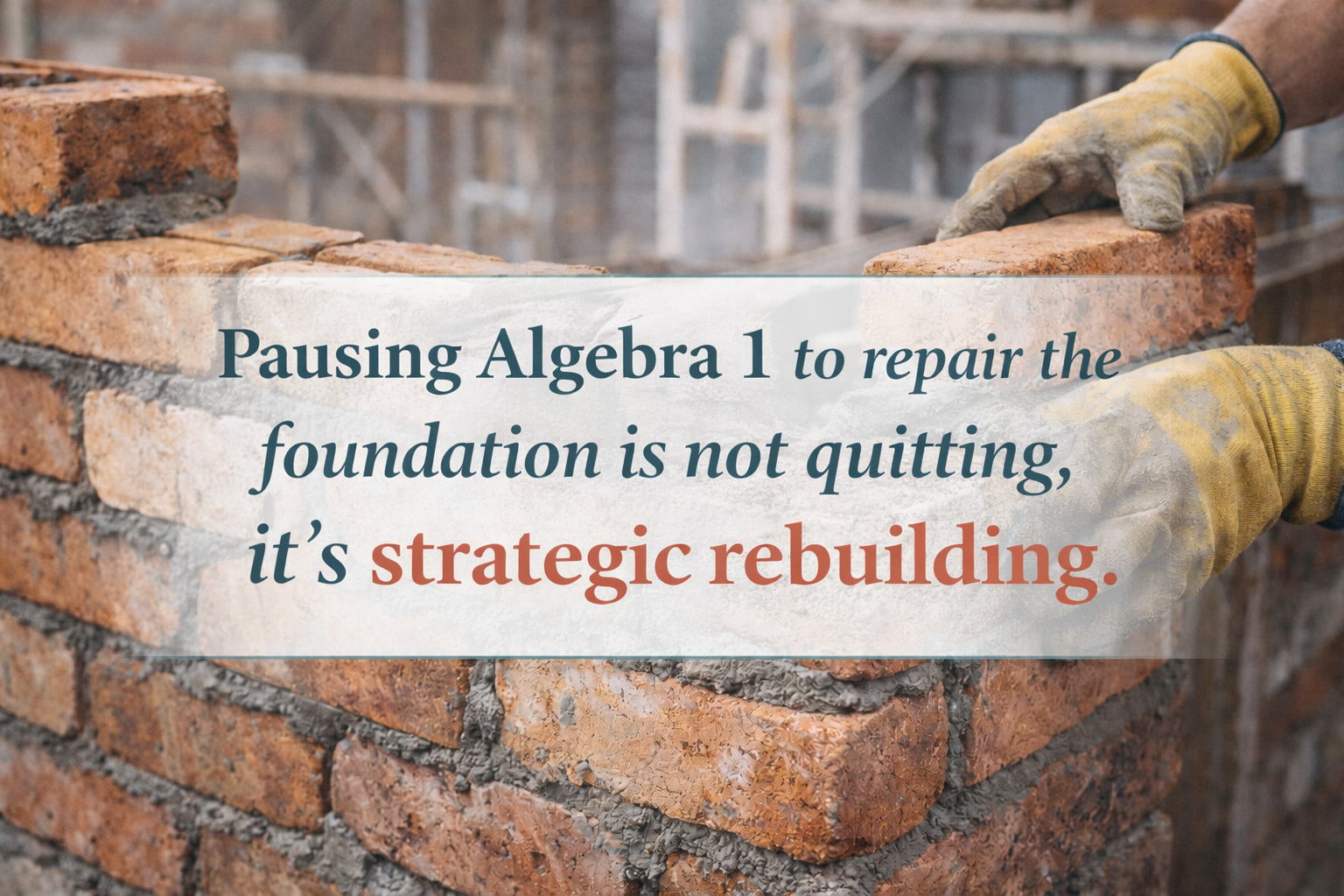
At that point, the wiser move may be to:
• Step back from Algebra 1 temporarily.
• Obtain a clear assessment of foundational gaps.
• Repair Pre-Algebra concepts intentionally and thoroughly.
Geometry as Strategic Forward Motion
For some students, Geometry can serve as a healthy reset year.
Geometry is:
• Visual
• Logical
• Structured differently
A solid Pre-Algebra foundation is usually enough for success in Geometry. Full Algebra 1 fluency, while helpful, is not as structurally central in most Geometry courses.
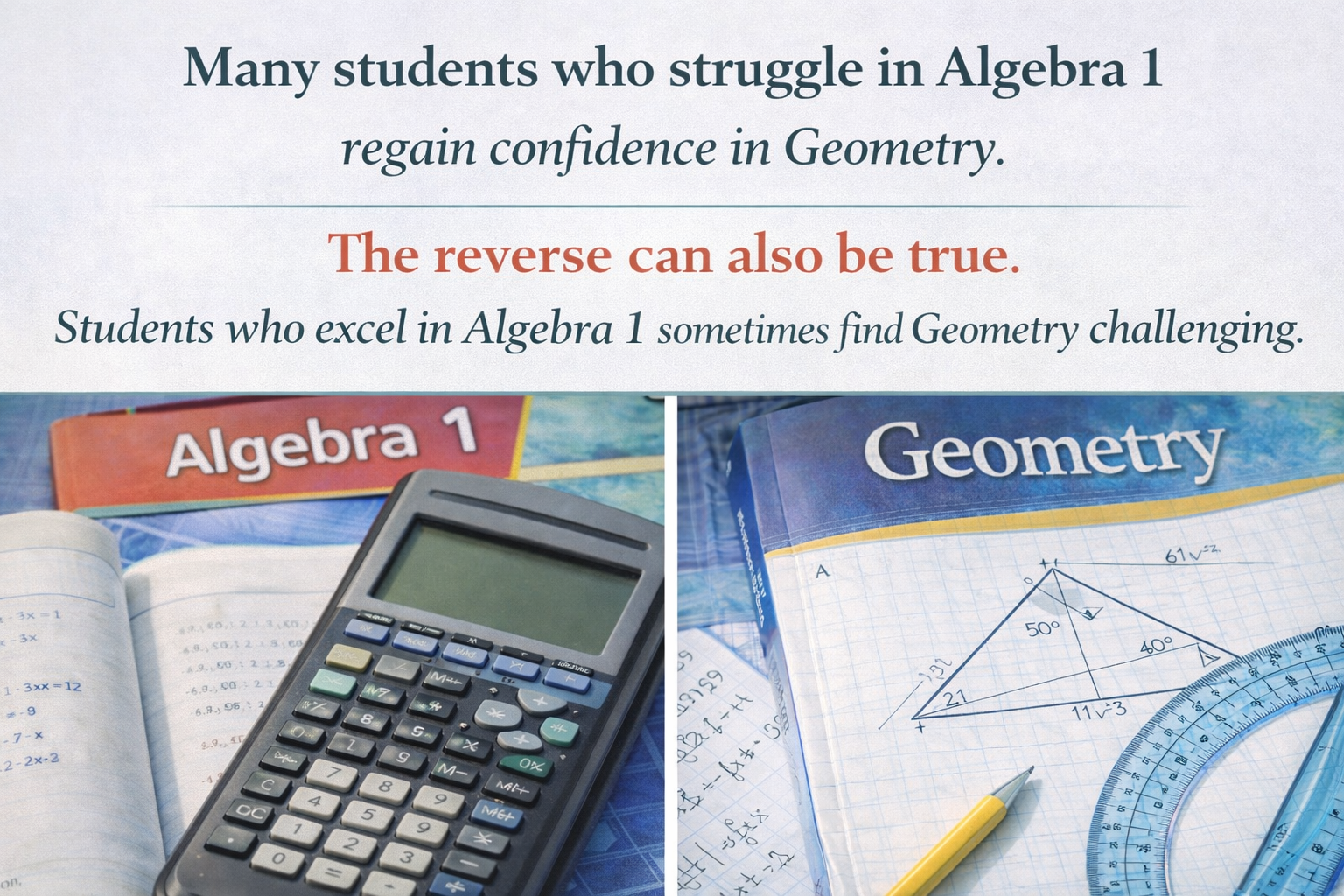
Many students who struggle in Algebra 1 regain confidence in Geometry.
The reverse can also be true.
Students who excel in Algebra 1 sometimes find Geometry more challenging. Algebra relies heavily on procedural fluency and symbolic manipulation.
Geometry shifts toward spatial reasoning, diagram interpretation, and formal justification. A student who is comfortable following algebraic steps may need time to adjust to constructing logical arguments and analyzing visual relationships.
If Geometry becomes the next step, it should not be an exit from Algebra 1.
It should be forward motion while foundational repair continues intentionally.
After completing Geometry, pause for an honest evaluation of Algebra 1 readiness.
·Which skills are solid?
·Which are still fragile?
·Where does symbolic reasoning still collapse under pressure?
The goal is not to repeat Algebra 1 in full.
The goal is to strengthen any remaining structural weaknesses before entering Algebra 2 so that the student is well prepared for success.
Algebra 2 builds heavily on Algebra 1 concepts. When those concepts are stable, Algebra 2 becomes manageable. When they are not, it can quickly become overwhelming.
Taking time to reinforce specific skills before advancing is not a setback.
It is architectural maintenance.
Keep the Doors Open
Does your child need to finish every page of Algebra 1?
It depends.
Part of that answer rests on the curriculum itself.
If the remaining portion is largely cumulative review and the essential skills are already stable, completing every assignment may not be necessary.
If the remaining portion introduces new algebraic concepts that directly support Algebra 2, then yes, those concepts matter.
This is not about getting by or rushing to place a check in the box.
It is about being well prepared.
Algebra 2 assumes fluency with linear equations, systems, functions, exponents, factoring, symbolic manipulation and more. When those foundations are secure, Algebra 2 becomes a natural extension. When they are incomplete, the next level magnifies the weakness.
The goal is not checking off every page.

If Algebra 1 has felt heavier than it should, that is not a sign to lower the ceiling.
It may be a sign to strengthen the structure.
When Algebra 1 becomes a constant struggle, there are usually specific foundational gaps underneath it. Those gaps can be identified clearly and repaired strategically.
If you would like a structured evaluation of your child’s Algebra 1 foundation and a clear plan for strengthening any weak areas, I would be glad to help.
Let’s make sure the structure is solid before moving forward.
Click here to schedule your FREE Consultation.

About the Author
Beth Bowen is the founder of Math Mentor Tutoring, where she works with middle school and high school students to build strong mathematical foundations and confident reasoning. A former public high school math teacher and longtime homeschool parent, she brings both classroom experience and personal insight to math placement decisions.
Mrs. Beth specializes in Algebra readiness, strategic sequencing, and targeted foundation repair. She is passionate about reducing test anxiety, equipping students with practical learning tools, and helping families build math confidence that lasts beyond a single course or exam.
She believes that lack of knowledge does not mean lack of intelligence, and that with the right structure and support, students can grow into confident, capable math thinkers.


