Current Teaching Textbooks Promotion!
Table of Contents
How it brought more independence and flexibility to our homeschool.
Video instruction, spiral review, immediate feedback, built-in support, and a physical textbook option for going off screen.
A question many homeschool parents ask. Read about our experience.
A parallel tutoring approach that strengthens foundations while students continue moving forward.
Why We Switched to
Teaching Textbooks
I first discovered Teaching Textbooks in 2014. At the time, I was homeschooling three children across three different grade and ability levels, and teaching all subjects myself.
As many homeschool families know, some subjects can easily be presented to all age levels at once. History, for example, can often be taught together as a family while assignments vary according to each child’s ability and grade level. Math was different.
At the time, my two older children happened to be working in the same math level. In some ways that was helpful because it allowed me to teach both kids with one lesson instead of two. But it also created a challenge. One child was capable of moving more quickly and grasped concepts easily, while the other needed a slower pace and more review. Keeping them together often meant slowing one child down while trying not to leave the other behind.
Wasn’t this one of the things we chose to homeschool in order to avoid?
Math was also consuming a large portion of our homeschool day.
Each morning I taught the math lessons. Then my children worked independently and placed their books on my desk to be checked. As I had time, I corrected work and sent assignments back for revisions so they could correct careless mistakes.
Later in the day I had to find time to check their answers again, and this time reteach any concepts that simply needed more instruction. Much of the day revolved around this cycle.
And my oldest was only in 6th grade math. It was exhausting.
As higher-level math drew closer, I realized I needed a curriculum that allowed my children to develop more independence while still giving me the ability to stay involved and support them when needed.
That search eventually led us to Teaching Textbooks.
There is no perfect curriculum, and you can certainly find varying opinions about any program available today. But Teaching Textbooks solved several practical challenges for our family in a way that made homeschooling more sustainable and allowed each child greater flexibility to learn at their own pace.
What We Appreciated About Teaching Textbooks
Over the years, there have been many features of Teaching Textbooks that worked especially well for our family and for many of the tutoring students I have worked with.
Video Instruction
One of the biggest changes for our homeschool was that my kids no longer had to wait for Mom to teach every lesson before moving forward. My stronger math kids could continue progressing at their own pace, while my child who needed more support could pause, replay instruction, and work more slowly when needed.
Sometimes my children still preferred live instruction from Mom, and there are certainly times when nothing replaces the value of real-time teaching and discussion. However, even then the video instruction provided a strong first exposure to new concepts and created far more independence within our homeschool day.
Built-In Help Features
Every single problem is programmed into the system. If a student becomes stuck and does not know how to begin, there is a built-in “Hint” feature available for support. Many times, this small amount of guidance was enough to keep my children progressing independently without frustration completely shutting them down.
Students also receive immediate feedback after submitting answers and can view step-by-step solutions when needed. This creates opportunities for students to learn from mistakes in real time rather than waiting for all work to be checked later.
Spiral Review & Skill Retention
Teaching Textbooks follows a spiral approach, continually reviewing concepts from previous lessons. As many parents have heard, “use it or lose it” is very true in math.
Regular review helped keep previously learned skills fresh instead of quickly forgotten after a single chapter test.
I also appreciated that problems are labeled according to the lesson where the concept was originally taught, making it easy for students to return to prior notes or lessons for review.
Flexibility On and Off the Screen
One concern I had when choosing a math curriculum was screen time.
While Teaching Textbooks provides video instruction, automatic grading, and online support, I still wanted my children to complete their math work with pencil and paper whenever possible.
For that reason, we always purchased the physical textbook and answer key sets, often finding gently used copies at very reasonable prices on eBay, Amazon, or Marketplace. (Rest assured, you can purchase new physical textbooks and answer keys directly from Teaching Textbooks.)
When we first started using Teaching Textbooks, all three of my children shared a single laptop. They would rotate through watching the lesson, working problems from their textbooks, and then return to the computer to enter their answers, make use of hints as needed, and get immediate feedback on how they were doing. The system worked remarkably well and allowed each child to progress independently without needing constant access to a device.
Today, Teaching Textbooks can be accessed on computers, tablets, and phones, making it even more convenient for families. Even so, I still appreciate that students can work primarily on paper if they choose.
For our family, having an off-screen option was not just a nice feature. It was an important requirement when evaluating curriculum choices.
Parent-Friendly Structure
The built-in gradebook allowed both students and parents to easily monitor progress throughout the school year. This helped create accountability while also making record keeping simpler for our homeschool.
Teaching Textbooks also offers flexibility in how families choose to use the curriculum. We personally used a combination approach with video instruction and grading while also purchasing the physical worktexts, tests, and answer keys. Having both options available gave us flexibility on days when we wanted to work away from screens.
Teaching Textbooks didn't simply help my children learn math. It also fit the practical realities of homeschooling multiple children with limited time and resources.
Is Teaching Textbooks College Prep?
My two older children used Teaching Textbooks beginning with Pre-Algebra, while my youngest child has worked through every level from 3rd Grade through Pre-Calculus.
One of the greatest benefits for our family was the flexibility it created. Because my children no longer had to wait for Mom to teach every lesson before moving forward.
My stronger math kids were able to progress more quickly and independently. This created opportunities to move well beyond the standard high school math sequence.
One of my daughters completed five college math courses through dual enrollment while still in high school.
The other completed Pre-Calculus Algebra & Pre-Calculus Trig as an 11th grader and even spent time helping tutor some of her college-aged classmates.
She is now preparing to take Calculus I through our local community college before her senior year of high school even begins.
Of course, no curriculum guarantees success on its own. Student effort, consistency, parental involvement, and appropriate support all play important roles in long-term math growth.
However, our family’s experience showed that Teaching Textbooks can absolutely provide a strong pathway into higher-level mathematics and college coursework.
How Teaching Textbooks Works
Alongside Tutoring
Over the years, I have worked with many students using Teaching Textbooks both within my own homeschool and through tutoring sessions with other families.
One thing I appreciate about Teaching Textbooks is that it creates enough structure and independence for students to continue progressing consistently while still leaving room for personalized support when needed.
Sometimes students simply need another explanation presented in a different way. Sometimes they need help strengthening foundational gaps that existed long before the current lesson. Other times they benefit from accountability, encouragement, strategy instruction, or guided practice through more difficult concepts.
This is one of the reasons I often describe my tutoring approach as “parallel tutoring.” While students continue progressing through their current curriculum, we also work intentionally to strengthen underlying foundational skills at the same time.
Teaching Textbooks
provides excellent ongoing instruction and spiral review,
while
IXL
allows me to pinpoint and reinforce very specific foundational skills that may need additional practice.
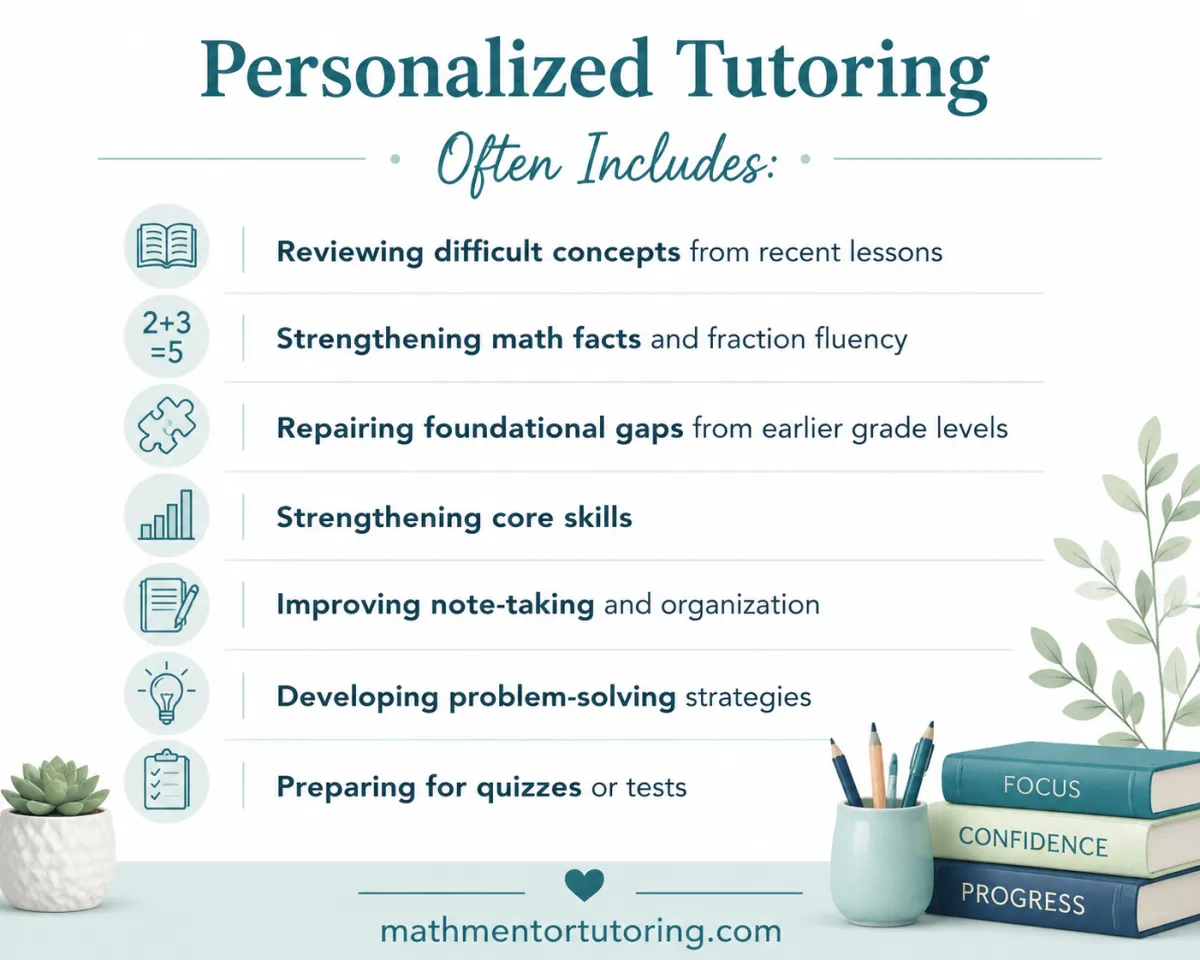
Teaching Textbooks provides the curriculum structure, while tutoring and targeted reinforcement create opportunities for individualized guidance and support based on each student’s unique needs.
Every student is unique, and one of the greatest strengths of homeschooling is the flexibility to combine resources and support systems in ways that help each child grow with confidence.
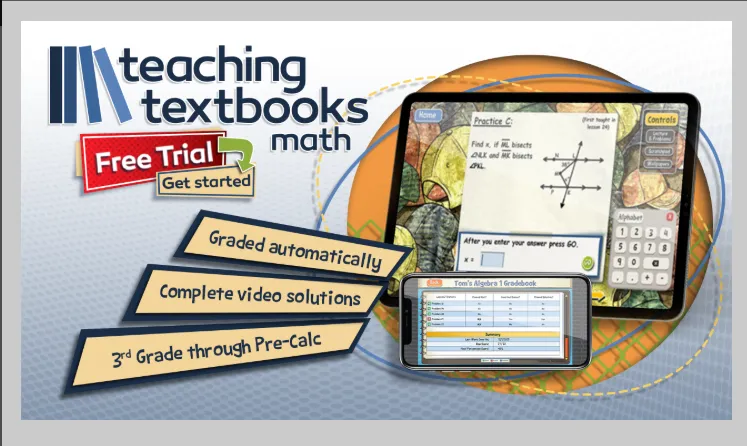
If you are unsure about placement, pacing, or whether Teaching Textbooks may be a good fit for your child, feel free to reach out.
I am always happy to share insight from both my personal homeschool experience and my work with tutoring students.
Disclosure: As a Teaching Textbooks affiliate, I may earn a small commission if purchases are made through links on this page. This comes at no additional cost to your family.
Hi! I’m Mrs. Beth
and I’d love to meet you and your child for a
Free 30-Minute Consultation
🎥 Watch this short welcome video
Proud to be Associated with the Following Organizations