Is It Too Late to Catch Up in Math?
Is It Too Late to Catch Up in Math This Year?
How spring and summer can help rebuild the foundation
before the next level of math begins.
Many parents reach this point in the school year feeling discouraged about math.
Despite everyone’s best efforts, the year may have been filled with frustrating homework sessions, confusing lessons, or disappointing test scores. When the school year is nearly over, it is natural to start wondering:
Is it simply too late to fix this?
The encouraging news is that it is not too late to make meaningful progress.
In many cases, students can still improve their grades during the remaining weeks of the school year. But even more important than the final number on the report card is rebuilding the understanding behind the math.
When the foundation becomes stronger, the next math course becomes far less intimidating and much more achievable.
Why Math Can Suddenly Become Difficult
When a student struggles in math for an entire year, it often has less to do with ability and more to do with how foundational skills develop over time.
Sometimes the challenge is not the student, and it is not the curriculum. It is the sequence.
A growing trend I’m seeing for students across the nation is that teachers do not always move straight through the textbook in order, particularly second semester and especially during testing season. They may complete full chapters, but in a different sequence than the book was designed to follow.
The difficulty is that textbook companies order their chapters according to a logical sequence. Well-written textbooks will also provide spiral review so that students continue to be exposed to previously covered concepts. When the order changes, the benefits of spiral practice are eliminated. Also, students may be asked to use a skill before it has had enough time to become comfortable and, in some cases, before it is introduced.
Confusion can be caused by randomness in the progression.
Another difficulty that arises is as more skills are added, the missing foundational knowledge pieces really become more obvious.
For example: not having a strong grasp of integer rules and exponent rules causes great difficulty with multiplying polynomials and factoring to solve.
Wondering what gaps may be holding your child back? Let’s take a look together.
CLICK HERE to Schedule a Consultation today.
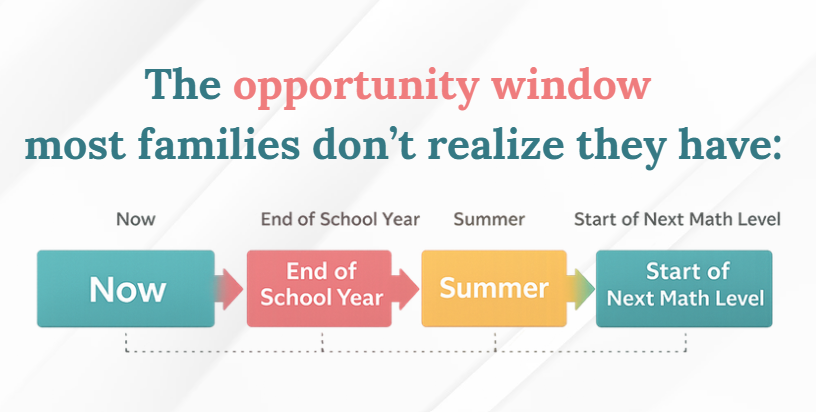
Even though the school year is nearing its end, there is still a valuable window of time to begin repairing the foundation.
The key is to think beyond the school calendar and look at the months ahead.
Now → End of School Year → Summer → Start of Next Math Level
Beginning now allows students to start addressing the gaps that have made math feel so difficult this year.
During the final weeks of the school year, teachers are often balancing standardized testing and required curriculum pacing. Because of this, there is rarely enough time in the classroom to slow down and rebuild foundational skills.
However, beginning repair in parallel can make a tremendous difference.
When students finally start understanding the skills that previously felt confusing, the sense of frustration often begins to fade. Even a small shift in understanding can bring a sense of calm back to math.
Why Summer Can Be a Powerful Reset
Once the school year ends, the pressure of tests, deadlines, and packed schedules drops significantly.
Summer provides something the school year provides little of. It provides time and space for targeted review.
Instead of rushing through new topics, students can revisit the skills that support the next level of math. Fractions, ratios, integers, equations, and other foundational ideas can finally receive the steady practice they need to become secure.
When these foundations strengthen, students often experience something surprising.
Math begins to feel possible again.
Confidence grows because the student is no longer trying to build new concepts on top of shaky ground.
There is still time to rebuild the foundation before next year begins.
Get Guidance for the Months Ahead
Rethinking the End of the School Year
It can be tempting to see May as the finish line. Many families understandably want to close the books and move on once the school year ends.
But for students who have struggled in math this year, the end of the school year does not have to mean the end of the opportunity to improve.
Instead, it can become the starting point for rebuilding the skills that support the next level of math.
With the right approach, the months between now and the beginning of the next school year can transform anxiety about math into renewed confidence.
And when the next math course begins, whether that is Pre-Algebra, Algebra 1, or another level, your child can start from a much stronger foundation.
A Simple Next Step
If this school year has felt frustrating, you are not alone.
Many families reach this point unsure of what to do next. But the most important step is not waiting for a fresh start in the fall. It is beginning, even in a small way, to rebuild the foundation now.
The progress does not have to be perfect. It simply needs to begin.
A few consistent weeks of focused practice can start to close gaps in math skills. A summer of steady, manageable work can rebuild confidence and strengthen the understanding needed for success in the next level of math.
If you are unsure where to begin, or which gaps may be holding your child back, I am always happy to help guide that process.
Sometimes a short conversation can bring clarity and direction for the months ahead.
You’re doing important work.
Move wisely. Build well.

About the Author

Beth Bowen is the founder of Math Mentor Tutoring, where she works with middle school and high school students, grade 6 through Algebra 1, to build strong mathematical foundations and confident reasoning. A former public high school math teacher and longtime homeschool parent, she brings both classroom experience and personal insight to math placement decisions.
Mrs. Beth specializes in Algebra readiness, strategic sequencing, and targeted foundation repair. She is passionate about reducing test anxiety, equipping students with practical learning tools, and helping families build math confidence that lasts beyond a single course or exam.
She believes that lack of knowledge does not mean lack of intelligence, and that with the right structure and support, students can grow into confident, capable math thinkers.
Mrs. Beth serves families in Baldwin County, AL, surrounding areas, and across the nation via both in person and online tutoring.


