
Should We Wait Until Next School Year to Fix Math Gaps?
Should We Wait Until Next School Year to Fix Math Gaps?
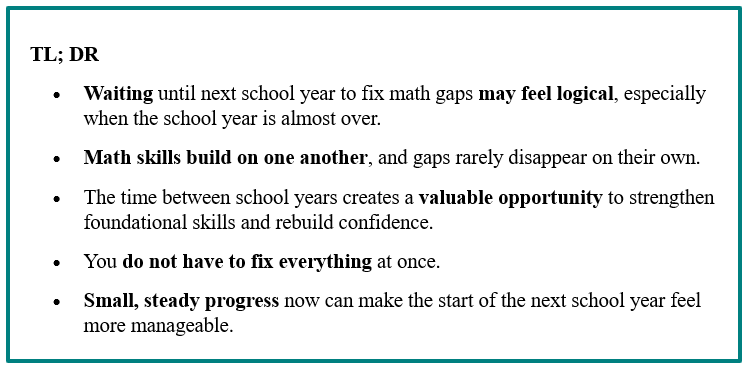
Why Waiting Can Feel Like the Most Reasonable Choice
As the school year winds down, many parents find themselves pondering these questions:
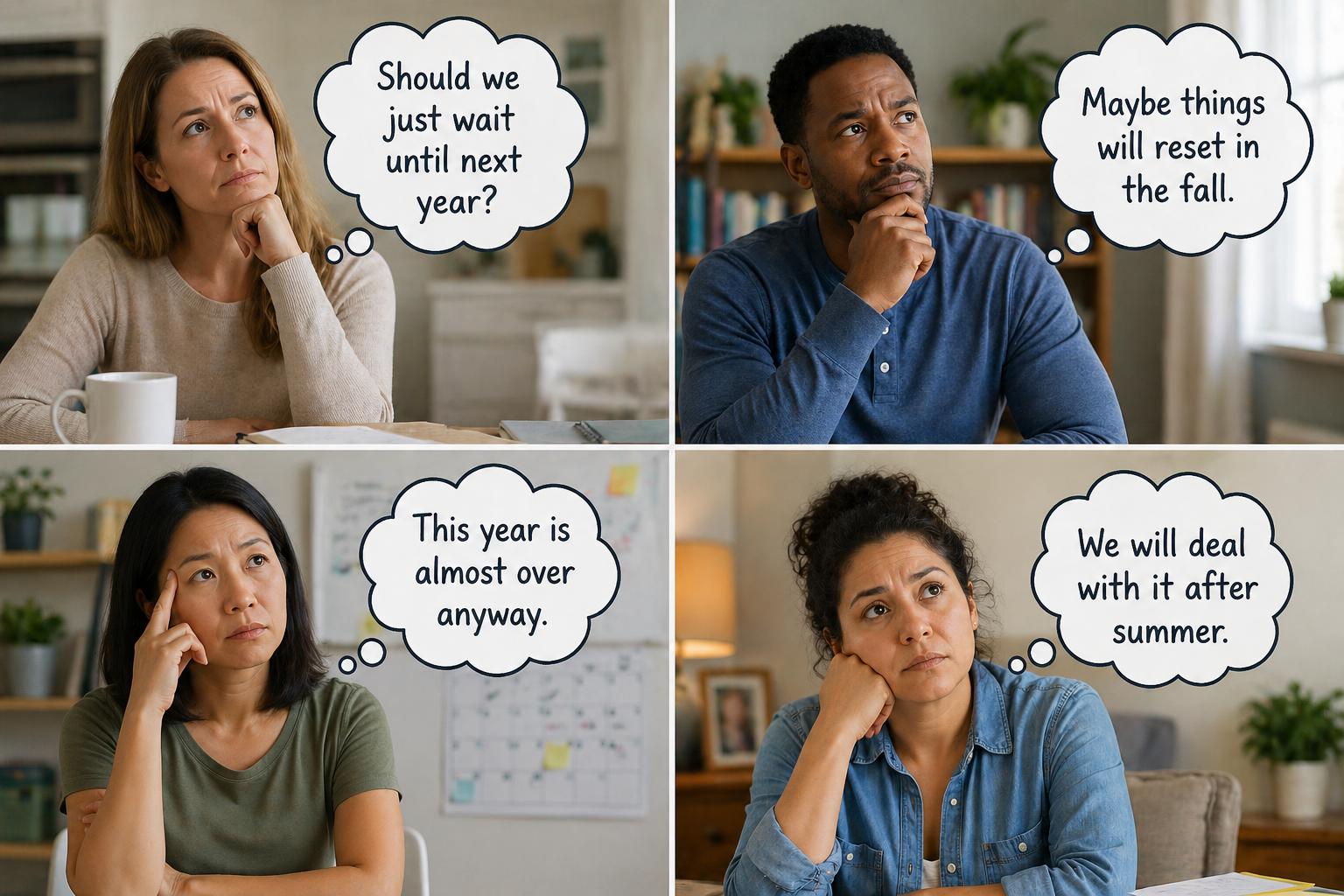
These thoughts are incredibly common.
And honestly, they make sense.
By the end of the school year, it can feel like the outcome is already set. The calendar is winding down, summer is approaching, and many families are simply trying to finish strong. It is easy to wonder whether extra effort right now will really make a difference.
So waiting can feel like the most reasonable choice.
But in math, waiting often makes the problem harder.
Not because anyone is doing something wrong.
Not because students are not capable.
Math builds step by step. When a step is missing, the next one becomes harder to climb.
Education research consistently shows that gaps in foundational math skills make future learning more difficult because math concepts build on one another (Center on Reinventing Public Education, 2025).
That is why waiting rarely makes the problem disappear.
It usually makes the next level feel more frustrating than the last.
If Progress Is Still Possible, Why Do So Many Families Consider Waiting?
In the previous post, Is It Too Late to Catch Up in Math?, we explored an encouraging message:
Progress is still possible, even late in the school year.
Students can rebuild missing skills, strengthen their understanding, and regain confidence when they receive the right support and focused practice. The remaining weeks of the school year can still be used to strengthen the foundation before the next level of math begins.
But once parents begin to see that progress can happen, a new question naturally follows:
Should we just wait until next school year to fix the problem?
It is a very reasonable question.
And for many families, it feels like the practical choice.
After all, the school year is almost over. Summer is coming. A new teacher and a fresh start are right around the corner.
So it makes sense to wonder:
Would it be easier to just begin again next year?
That is exactly what we are going to explore next.
Why Waiting Until Next Year Can Feel Like the Practical Choice
Waiting until next school year can feel like the most practical decision.
By this point in the year, many families are simply tired. Students are ready for a break. Parents have been managing schedules, homework, activities, and responsibilities for months. Teachers are working to finish lessons, complete testing, and close out the year.
Everyone is ready to exhale.
It is completely understandable to look at the calendar and think:
"We have made it this far. Let's just finish the year and start fresh in the fall."
That thought is not careless.
It is not lazy.
It is not a lack of concern.
In many ways, it is a sign of responsible parenting. Families are trying to make thoughtful decisions about timing, energy, and what is realistic for their child.
Waiting can also feel hopeful.

A new school year brings new routines, new expectations, and often a new teacher. It can feel like a natural reset point. Many parents assume that the next year will provide a fresh start and that things will fall into place once school begins again.
And sometimes, that does happen.
But often, the challenges that showed up this year are still there when the next year begins. The calendar changes, but the underlying skills remain the same.
That is why this decision deserves a closer look.
What Actually Happens When Students Wait to Fix Math Gaps
When families decide to wait until next school year to address math gaps, the intention is usually to give everyone a break and start fresh later. That decision often feels reasonable in the moment.
But math does not pause while we wait.
Math skills build on one another. Each new topic depends on understanding the ones that came before it. When a foundational skill is shaky or missing, the next lesson becomes harder to understand, even when the student is trying their best.
This is why students sometimes say:
"I studied, but I still don't get it."
"I paid attention, but the problems don't make sense."
"I thought I understood this last year."
What looks like a new struggle is often an older gap showing up again.
For example, a student who is unsure about fractions may begin to struggle when ratios are introduced. A student who is uncomfortable with negative numbers may feel confused when working with equations. The difficulty is not caused by the new topic itself. It is usually connected to a skill that needed more time and practice earlier.
When those gaps remain in place, the next school year often starts with more pressure instead of a fresh start. New material arrives quickly, expectations increase, and students may feel behind before they have a chance to catch their footing.
Research supports this pattern. Studies of learning progression show that students who begin a school year with unfinished foundational skills often experience increasing difficulty as content becomes more complex. In subjects like mathematics, where concepts are sequential, small gaps can grow into larger obstacles over time (RAND Corporation, 2021; National Mathematics Advisory Panel, 2008).
This does not mean students cannot catch up.
It simply means the work becomes harder when gaps are left unaddressed.
And that is why timing matters.
Addressing gaps earlier gives students more room to practice, more time to build confidence, and a smoother path into the next level of math.
Why This Time of Year Creates a Unique Opportunity to Strengthen Math Skills
Something important begins to change as the school year moves toward its final stretch.
For some students, the pace begins to slow once testing is complete.
For others, the pace actually feels faster as teachers work hard to finish the remaining required concepts before the semester ends.
Both situations are normal.
In many classrooms, this time of year can feel rushed. Lessons may move quickly. Assignments may cover several topics at once. Students and families may feel like they are working hard just to reach the finish line.
For some students, this pace can feel overwhelming. They may feel confused, discouraged, or unsure where to start. They may work hard and still feel like they are falling behind.
That reaction is not a sign of laziness or lack of effort.
It is often a sign that the pace has simply moved faster than their foundation was ready for.
That is exactly why this season creates a unique opportunity.
Even when the classroom pace is intense, the calendar itself is shifting. The pressure of long-term grading cycles, major testing windows, and new unit launches begins to fade. A natural transition is approaching.
And transitions create space.
Not always immediately.
Not always perfectly.
But predictably.
During most of the school year, nearly all math time is spent keeping up with new material. Teachers have pacing guides to follow and standards to cover. Students move from lesson to lesson with very little time to revisit skills that were confusing the first time around.
As the school year closes, that forward push eventually pauses.
And when it pauses, even briefly, something valuable becomes possible.
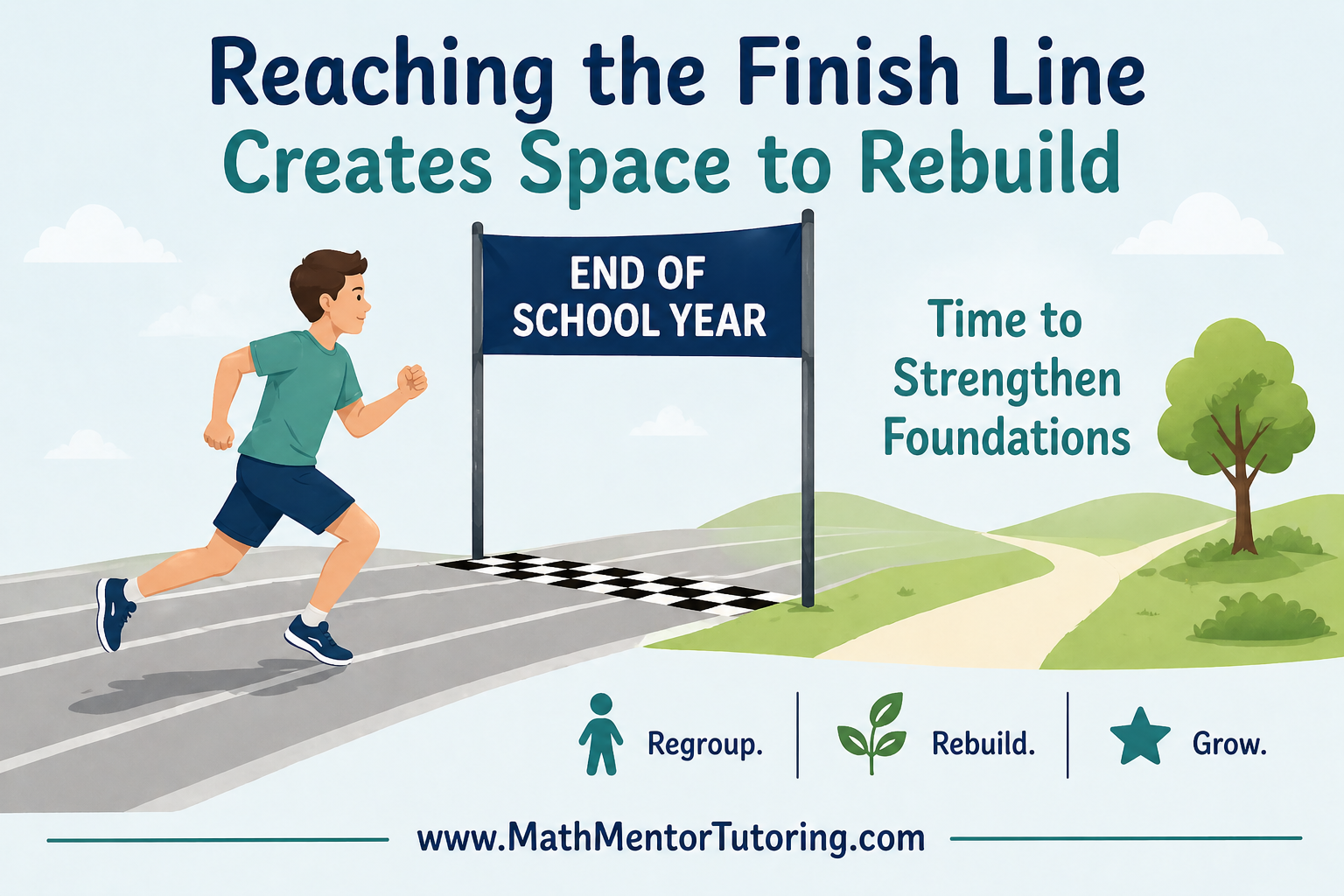
Students can strengthen the skills that support everything else.
This is why late spring and early summer can be such a powerful time to repair math gaps.
Not because the workload disappears.
But because the season creates an opening.
There is a natural break coming.
A chance to regroup.
A chance to rebuild confidence before the next level begins.
Many families are surprised to discover that progress often happens during this window, even when the previous months felt overwhelming. Without the pressure of constant new instruction, students can focus on the specific skills they need most and begin to feel more capable again.
This period is not about catching up all at once.
It is about using this window wisely.
And that window is closer than many families realize.
The Repair Window: A Strategic Time to Strengthen Foundational Skills
This period between the end of one school year and the beginning of the next is an excellent Repair Window.
It is a short but powerful stretch of time when students can strengthen the skills that support everything else, without the pressure of new lessons arriving every day.
The Repair Window is not about just doing more math.
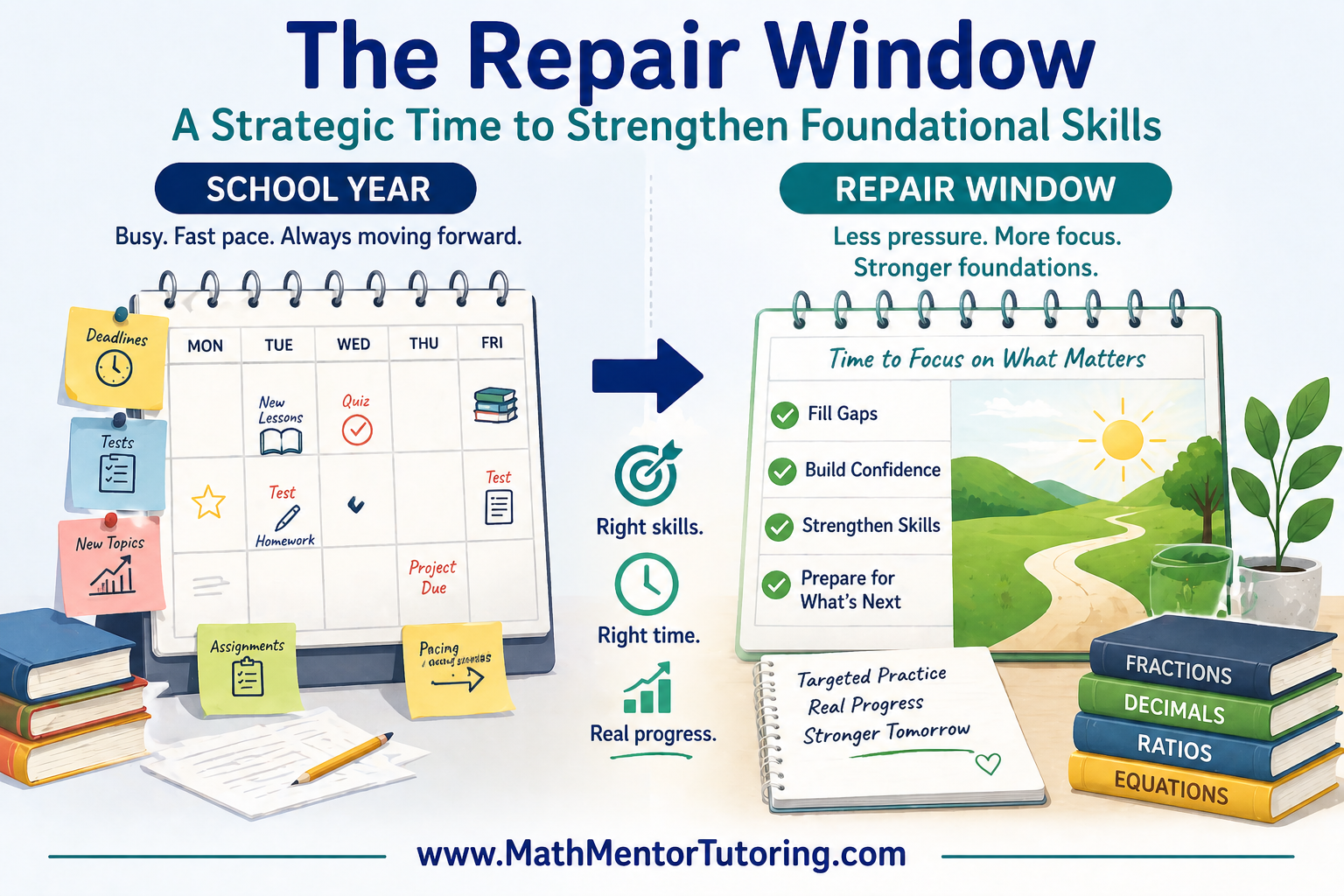
It is about doing math more intentionally.
Instead of rushing to keep up, students can take the time to focus on the skills that matter most. They can revisit concepts that once felt confusing, practice until understanding becomes more natural, and build confidence through steady progress.
This is also the time to pause and take a clear look at where support is truly needed. When practice is focused on the right skills and supported with consistent follow-through, students make steady progress.
The goal of the Repair Window is not perfection.
It is preparation.
Preparation for the next school year.
Preparation for new concepts.
Preparation for a stronger start.
When students use this window to strengthen their foundation, the next level of math often feels more manageable from the very beginning. Lessons make more sense. Frustration decreases. Confidence begins to grow.
And perhaps most importantly, students walk into the new school year believing they can succeed.
In the next post, we will look at what this can look like in real life and how families can create a simple, realistic plan to use this window wisely.
Preparing Now Makes the Start of Next School Year Feel More Manageable
Many families assume that the next school year will bring a fresh start.
And in many ways, it does.
New teachers.
New routines.
New opportunities.
But the strongest starts do not happen by accident.
They are built ahead of time.
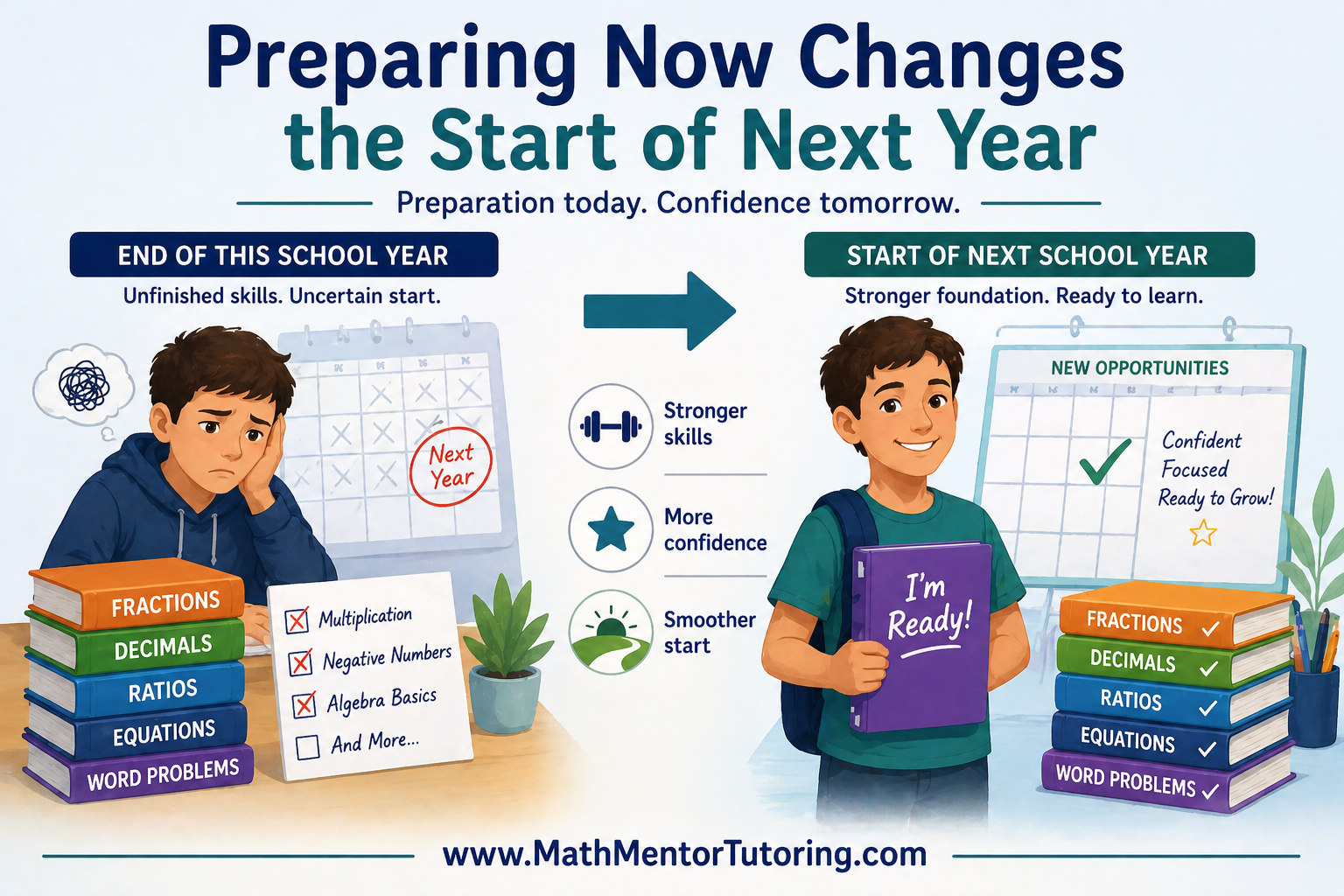
Students who begin the year with a stronger foundation often feel more confident from the very first weeks of school. They are better able to follow new lessons, complete assignments with less frustration, and participate more comfortably in class.
That confidence does not come from just doing more work.
It comes from doing the right work consistently.
Even small, steady progress during the Repair Window can make a meaningful difference in how the next school year feels. Not because everything is suddenly easy, but because students are no longer trying to build new skills on top of uncertainty.
The goal is not to fix everything at once.
The goal is to make the next step feel manageable.
And that is what preparation provides.
In the next post, we will walk through what this can look like in a practical, realistic way. We will talk about how families can use the Repair Window to create a simple plan that fits their schedule, supports their child, and builds confidence for the new school year ahead.
References
Center on Reinventing Public Education. (2025).
A Crisis in Math: The State of the American Student 2025.
https://crpe.org/the-state-of-the-american-student-2025
National Mathematics Advisory Panel. (2008).
Foundations for Success: The Final Report of the National Mathematics Advisory Panel.
U.S. Department of Education.
https://www2.ed.gov/about/bdscomm/list/mathpanel/report/final-report.pdf
Wondering Whether Now Is the Right Time?
If your child has struggled with math this year, you do not have to figure out the next step alone.
The weeks between school years can be a powerful time to strengthen foundational skills and rebuild confidence before the next level begins. Even small, steady progress during this season can make the start of the new school year feel much more manageable.
If you would like help identifying where your child needs support and creating a plan that fits your family's schedule, I would be glad to talk with you.
Schedule a free consultation to discuss your child's math needs and explore how the Repair Window can be used wisely.


About the Author
Beth Bowen is the founder of Math Mentor Tutoring, where she works with middle school and high school students, grade 6 through Algebra 1, to build strong mathematical foundations and confident reasoning. A former public high school math teacher and longtime homeschool parent, she brings both classroom experience and personal insight to math placement decisions.
Mrs. Beth specializes in Algebra readiness, strategic sequencing, and targeted foundation repair. She is passionate about reducing test anxiety, equipping students with practical learning tools, and helping families build math confidence that lasts beyond a single course or exam.
She believes that lack of knowledge does not mean lack of intelligence, and that with the right structure and support, students can grow into confident, capable math thinkers.
Mrs. Beth serves families in Baldwin County, surrounding areas, and across the nation via both in person and online tutoring.


