Contact Us
Why Does Math Suddenly Feels Harder After Winter Break?

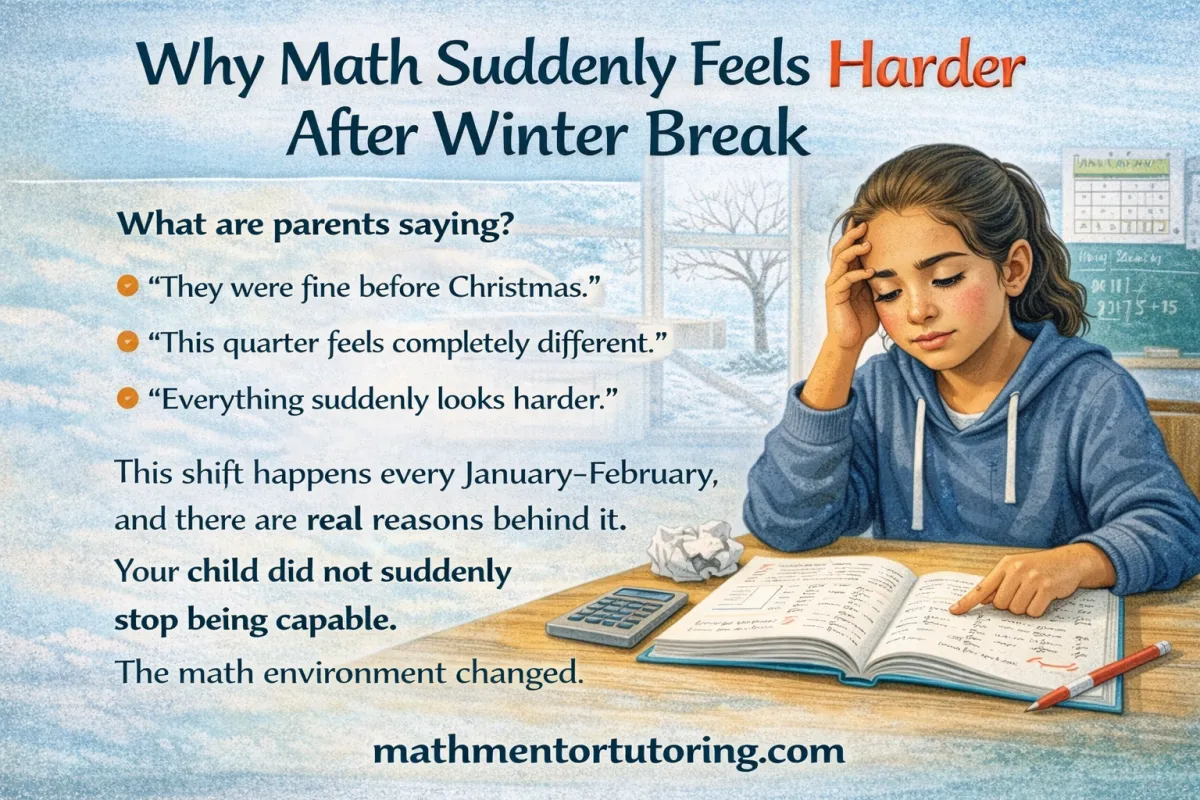
Why Math Suddenly Feels Harder After Winter Break
If your child came back from winter break and suddenly feels lost in math, you are not imagining it.
What are parents saying?
“They were fine before Christmas.”
“This quarter feels completely different.”
“Everything suddenly looks harder.”
This shift happens every January-February, and there are real reasons behind it.
Your child did not suddenly stop being capable.
The math environment changed.

Winter Break Disrupts How Math Is Stored in the Brain
Learning scientists have long studied something called the forgetting curve, which shows that when information is not used, it fades quickly, especially in the first hours and days after learning.
The German psychologist Hermann Ebbinghaus first described this phenomenon in the late 1800s and found that without regular review, newly learned information fades rapidly from memory.
Recent work replicating Ebbinghaus’s original experiments confirms this pattern.
This is especially true for math, which depends on fast recall of procedures, facts, and patterns. Math skills often go unused for two or three weeks during winter break. Fractions, equations, and problem-solving routines weaken and can feel harder to access without practice.
Researchers also describe the spacing effect, which explains that learning needs frequent retrieval to stay strong. A long break interrupts that retrieval cycle, so students return with softer skills even if they understood them in December.
Click here to read the research.
When school resumes, teachers move forward. The curriculum does not slow down to wait for memory to catch up.
That gap between what students remember and what the class expects is what makes January feel so overwhelming.

The Pace Changes After the Holiday
Another hidden shift happens in January: pacing.
During the fall, teachers spend more time:
Reviewing
Reinforcing
Establishing routines
By midyear, that changes. The class is expected to:
Work more independently
Connect past concepts to new ones
Move through lessons faster
This is especially noticeable in middle and high school math classes. These levels rely heavily on prior skills. When those skills are even slightly rusty after winter break, students feel like the teacher suddenly started speaking a new language.

Math Is Cumulative, So Small Gaps Grow Fast
Math builds on itself. A student solving linear equations in January must still rely on:
Fraction fluency
Integer rules
Distributive property
Order of operations
If any of those pieces are weak, every new lesson feels harder than it should.
Education researchers call this cumulative learning. When one piece slips, everything above it becomes more fragile.
That is why confusion tends to snowball in January.

Why Your Child Feels Like They “Forgot Everything”
Many students are shocked by how quickly math feels unfamiliar after break. That reaction is normal.
The brain stores math differently than stories or vocabulary. It depends on automatic retrieval. When that retrieval slows down, students feel unsure, even when the knowledge is still there.
This is why a child may say:
“I used to know this, but now I don’t.”
They often do know it, but it is harder to access without the right support.

What Parents Can Do Right Now
The goal is not to redo the entire year.
The goal is to make math feel manageable again.
Here are practical steps parents can take immediately.
1. Create a dedicated, distraction-free math space
Make sure your child has a consistent place to work on math that is free from distractions and already stocked with the tools they need.Having everything gathered ahead of time reduces friction and frustration before homework even begins. This is where a Math Toolkit becomes especially helpful. When students know exactly where to find formulas, vocabulary, and reminders, they feel more confident and less overwhelmed.
Need help assembling a Math Toolkit for your child? Click here and I’ll walk you through.
2. Make math flashcard review a daily routine
Most people think of flashcards as just math facts, but effective math flashcards go far beyond multiplication tables.
Useful flashcards include:
Math vocabulary and definitions
Math rules such as “When are common denominators necessary?”
Reference cards like prime numbers, order of operations, or integer rules
Every homework session should begin with a quick flip through flashcards. This warms up the brain and strengthens recall before tackling new problems. Some students do best when a parent reads the cards aloud so they can respond verbally.
If you don’t already have flashcards like these, you can create simple ones at home on 3x5 index cards, or use a structured set designed to support math vocabulary, rules, and reference skills.
I’ve created math flashcard sets for my own students that follow this approach, and many families find it helpful to have everything organized in one place. If you’d like to see the type of math flashcards I use with students, you can find them on my website just click on the Resources tab.
No homework nights:
Even on nights with no homework, flashcard review should still happen. Repetition is key.
This is also a great time to rework a few problems from class notes.
Write a problem fresh on a blank sheet of paper and have your child solve it step by step without looking.
Then use the notes as a guide to check the work and catch any missed steps. Again, repetition builds confidence and fluency.
When Extra Support Becomes Helpful
These steps go a long way in helping math feel more stable again. For many students, this kind of consistency is enough to reduce stress and improve confidence.
Sometimes, though, parents notice that even with good routines in place:
Homework still takes an unusually long time
The same types of mistakes keep showing up
Their child understands explanations but struggles to apply them independently
Frustration or avoidance continues week after week
When that happens, it’s often a sign that there are specific skill gaps underneath the current material that need more targeted attention.
Extra support can be helpful at this point, not because a child isn’t trying or isn’t capable, but because math builds on itself. When earlier pieces are shaky, new lessons feel harder than they should.
The goal of support is not to rush or overwhelm. It is to quietly strengthen the foundation while helping students keep up with what’s happening in class. When that balance is in place, math often starts to feel manageable again.

January Is a Turning Point
Winter break did not cause your child to fail. It simply revealed where math needs support.
When the right pieces are strengthened, the fog lifts. Students stop guessing. Homework gets easier. Confidence comes back.
January is not the end of the road.
It is the moment to get back in sync with how math really works.
If you’d like help identifying what’s making math feel harder right now, you’re welcome to schedule a free consultation to talk through your child’s situation.
Click here to schedule your free consultation.

About the Author
Beth Bowen is the founder of Math Mentor Tutoring, where she works with middle school and high school students in grades 6 through Algebra 1, as well as students preparing for the math portion of the ACT and ACCUPLACER. She serves families locally in Fairhope, AL, Baldwin & Mobile Counties, and students across the nation through online tutoring.
Beth specializes in identifying hidden learning gaps and helping students rebuild strong math foundations so current coursework finally makes sense. Her approach combines curriculum alignment, diagnostic tools, and practical study strategies that reduce frustration and build confidence.
With years of experience working closely with students and parents, Beth is known for explaining why students struggle, not just how to fix it. Her goal is to help students feel capable, prepared, and confident in math again.
You can learn more at mathmentortutoring.com.