
Contact Us
How to Rebuild Math Foundations for Teens Without Using “Little Kid” Curriculum

I. Naming the Real Fear
Parents are concerned. Sometimes math struggles creep in slowly over time. A lesson here, a concept there, and before long something feels off. Other times, the gaps are uncovered all at once, often when a family pulls a child out of the school system and takes a closer look at what they truly understand. For many parents, that moment can be jarring. It raises uncomfortable questions and an urgent sense that something needs to be done.
Naturally, parents begin to worry. How far back do we need to go? Did we miss something important along the way? Have we unintentionally set our child up to struggle? These questions are especially heavy when the child is a teenager. At this stage, math is no longer just about numbers. It is tied to confidence, identity, and a teen’s belief in their own ability to learn.
The fear most parents don’t always say out loud is this: they want their child to catch up, but they do not want to humiliate them in the process. Teens do not want to be handed “little kid” math or placed into materials that feel far below their age. At the same time, pushing them forward into math they are not ready for often leads to frustration, shutdown, or burnout. The good news is that this is not an either-or situation. You do not have to choose between ignoring foundational gaps and placing a teen into elementary-level math to repair them.
For many homeschool families, this situation develops for understandable reasons. Math is often the one subject that does not naturally integrate with the rest of the homeschool day. Writing skills carry over into science, history, speeches, debate, and research projects. Students use what they learn in one area almost immediately in another. Math, however, tends to stand alone. Even in co-ops, students are often using different curricula and working at different levels, which means math time becomes more of a conversation than structured instruction. Over time, it is easy for math to slip to the bottom of the priority list, not because families do not value it, but because everything else connects so seamlessly.
When gaps surface under these circumstances, the instinct is often to “go back” and start over at a lower level, even though that approach can unintentionally create new challenges for teens.

II. Why “Just Starting Lower” Often Backfires for Teens
When a teen is struggling in math, starting at a significantly lower level can feel like the most responsible and cautious choice. After all, if something is missing, it makes sense to go back and fill in the gaps. However, for older students, this approach often introduces new challenges that have little to do with math itself.
Teens are developmentally different from younger students. They are forming a stronger sense of identity and are especially aware of how they are perceived by others. Placing a teenager into elementary-level math books or heavily simplified materials can unintentionally communicate more than academic gaps. It can signal that they are being treated as younger or less mature than they are at a stage when they are working hard to be seen as capable and growing. This mismatch between a teen’s developmental needs and the presentation of the material often leads to resistance, disengagement, or a quiet loss of confidence before meaningful progress ever begins.
Another issue with “starting over” is that it is rarely efficient. Most teens who are struggling in math do not need to relearn everything from earlier grades. Their difficulties are usually tied to specific missing skills that were never fully mastered or never connected properly. Sending a teen back through entire years of material means they spend significant time reviewing concepts they already know, while only occasionally encountering the skills they truly need. This slows progress and reinforces the feeling that catching up will take years, when that is often not the case.
Rebuilding math foundations is not about going backward in presentation. It is about identifying what is missing and repairing it intentionally, while keeping the student oriented toward forward progress. For teens, how the work is framed matters just as much as what is being taught.
III. A Better Approach: Parallel Progress Instead of Starting Over

Instead of restarting math at a much lower level, teens benefit most from an approach that allows them to move forward while intentionally repairing what is missing underneath.
For homeschool families, this means separating course placement from skill repair. A teen’s math course should reflect their age, maturity, and long-term trajectory, while foundational gaps are addressed in a targeted and systematic way. In most cases, this looks like placing students in an age-appropriate course, often Pre-Algebra or higher, while simultaneously working on the specific skills that never fully took root.
This parallel approach preserves momentum. Teens continue to engage with math that feels relevant and appropriately challenging, while the underlying gaps that cause confusion are repaired in the background. Instead of repeating entire years of content, students focus only on the skills they actually need, allowing progress to happen more efficiently and with far less frustration.
Just as importantly, this method protects confidence. When teens see themselves moving forward rather than being sent backward, they are more likely to stay engaged and willing to put in the work. Progress feels purposeful, not punitive. Over time, as foundational skills strengthen, grade-level material begins to feel more manageable and less overwhelming, often for the first time in years.
Rebuilding math foundations does not require choosing between dignity and rigor. With the right placement and a clear plan for targeted repair, teens can regain stability in math while continuing to move toward grade-level expectations.
What This Can Look Like in Practice
A teen may be placed in a Pre-Algebra course that matches their age and long-term goals, even if diagnostic results show gaps in earlier skills. While working through current lessons, targeted time is spent strengthening specific foundational skills such as fraction fluency, integer operations, or basic algebraic reasoning. Because the work is focused only on what is missing, students often move through these earlier skills quickly. As those gaps close, confidence increases and progress in the current course becomes more consistent.
Because the work is targeted rather than repetitive, students often progress through foundational gaps faster than parents expect, while continuing to move forward in their current course.
IV. How I Determine What Needs Repair
Rebuilding math foundations effectively requires more than intuition or guesswork. Before deciding what to reinforce, it is important to understand which skills are truly missing and which ones are already in place. Many students who appear “behind” actually have uneven skill development rather than a lack of ability across the board.
To gain that clarity, I use a comprehensive diagnostic process that evaluates math skills across multiple categories. This allows me to see patterns that are not always obvious from daily work or curriculum placement alone. Instead of assuming a student needs to repeat entire chapters or grade levels, I can pinpoint the specific skills that are preventing progress and focus attention there.
This approach also prevents unnecessary review. When a student demonstrates understanding in an area, we move on. When a gap appears, we address it directly. The goal is always efficiency with intention, not speed for its own sake. By targeting only what is needed, students spend less time feeling stuck and more time experiencing meaningful progress.
It is also important to set expectations early. Some of the initial skills identified may feel surprisingly basic, especially for teens. This does not reflect a lack of intelligence or effort. It simply indicates where understanding broke down at some point along the way. With clear guidance and consistent support, these gaps can often be repaired more quickly than families anticipate.
V. Addressing the “My Teen Will Be Offended” Concern
This concern is valid, and it deserves to be named openly. Many parents worry that even targeted foundational work may frustrate or offend their teen, especially when some skills appear far below their current grade level. No parent wants to damage their child’s confidence or make them feel labeled as “behind.”
What is important to understand is that being temporarily uncomfortable is not the same as being diminished. When teens encounter a missing skill, it can feel surprising or even irritating at first, particularly if they expected to be further along. However, when the purpose of the work is clearly explained and the progress is visible, that discomfort usually fades quickly. Teens are far more willing to engage when they can see that the work is purposeful and temporary, not a permanent step backward.
In practice, students often move through early gaps much faster than expected. Skills that may have been missed years ago can sometimes be repaired in weeks when instruction is targeted and guided. As teens experience success and notice that current math begins to make more sense, their confidence grows. The focus shifts from where they started to how far they are moving.
The goal is not to protect teens from every uncomfortable moment. The goal is to protect their sense of capability. With the right framing, support, and pacing, foundational work becomes empowering rather than discouraging.
VI. Why Pre-Algebra Is Often an Ideal Time to Rebuild Foundations
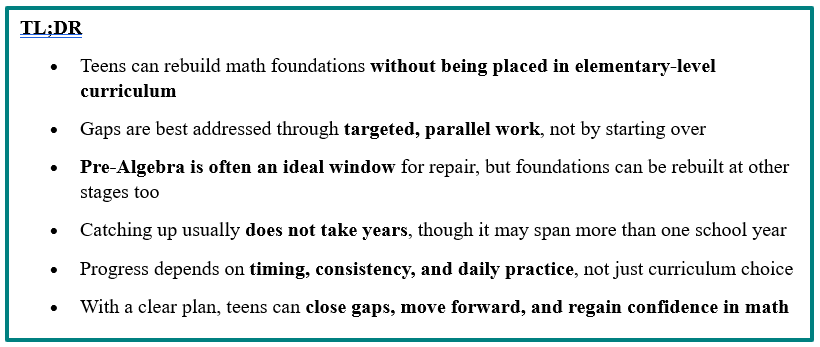
Pre-Algebra can be an especially effective stage for addressing foundational math gaps, particularly for students in the middle school years. This is not because learning must stop at that point, but because Pre-Algebra naturally revisits many core skills while beginning to introduce algebraic thinking. It offers a wide enough range of content to strengthen number sense, fractions, integers, ratios, and proportional reasoning, while still allowing space to repair gaps before math becomes more abstract.
That said, placement decisions should always take a student’s age, maturity, and current coursework into account. I would not typically recommend moving a 10th grader back into Pre-Algebra, and even for 9th graders, placement must be considered carefully. By that stage, students are often better served by remaining in Algebra 1 or another age-appropriate course while foundational gaps are addressed in parallel.
The goal is not to avoid Algebra 1, nor to suggest that it is an inappropriate place to rebuild skills. Many students successfully strengthen their foundations while working through Algebra 1 or higher. Pre-Algebra is simply a more forgiving window when available, allowing gaps to be repaired before the increased pace and cumulative demands of high school math take hold.
Ultimately, the best placement is one that balances developmental readiness with instructional needs. With a targeted plan and thoughtful pacing, students can rebuild foundations at multiple stages. The earlier those gaps are addressed, the smoother the path forward tends to be.
VII. What Catching Up Actually Looks Like
One of the most common questions parents ask is how long it will take for their child to get caught up in math. The reassuring answer is that rebuilding foundations does not usually take several years. However, it is also important to be realistic. Catch-up is a process, and in some cases it may span more than one school year depending on several factors.
Timing matters. A student who begins targeted foundational work early in the school year has more runway than a student who starts late in the spring. For example, a student who begins in April should not be expected to be fully caught up by the end of May. Progress still happens, but it continues over time rather than fitting into an artificial deadline.
Consistency is another key factor. The frequency of tutoring sessions and the amount of structured support a student receives each week directly affect the pace of progress. Just as important is what happens between sessions. I ask students to spend about 20 minutes each day working on their assigned foundational skills. When students consistently make that time, progress accelerates noticeably. When practice is sporadic, progress slows.
There are other factors that also influence the timeline. A student’s prior exposure to concepts, their confidence level, and their willingness to engage all play a role. Learning differences or working memory challenges may require additional repetition, while strong effort and focus can help students move more quickly through gaps. None of these factors are judgments; they simply help set realistic expectations.
What matters most is steady forward movement. With a clear plan, consistent effort, and targeted instruction, students typically make meaningful progress within the same school year and continue building toward grade-level confidence over time.
VIII. Reassurance
Discovering math gaps in the teen years can feel overwhelming, but it does not mean your child is beyond help or permanently behind. This situation is more common than many families realize, and with the right approach, it is absolutely workable. Rebuilding math foundations is not about starting over or labeling a student by where they struggle. It is about understanding what is missing and addressing it thoughtfully.
Teens are capable of remarkable growth when instruction respects their age, their effort, and their potential. When gaps are repaired intentionally and progress continues forward, math begins to feel more manageable and less intimidating. Confidence grows alongside skill, and students often realize they are far more capable than they believed.
If you are unsure where to place your teen in math or how to address gaps without sacrificing dignity or momentum, you do not have to figure it out alone. With a clear plan and consistent support, catching up is possible, and it can happen in a way that strengthens both understanding and confidence for the longterm.

Can this work if my teen is already in Algebra 1 or beyond?
Yes. Foundational gaps can be addressed at multiple stages, including during Algebra 1 and higher-level courses. While Pre-Algebra is often an ideal window when available, it is not the only opportunity for repair. For older students, foundational skills are strengthened in parallel while they continue working in age-appropriate math. The approach is adjusted based on the student’s current course, maturity, and specific needs.
Do I need to change curriculum to do this?
Not necessarily. Many students can remain in their current curriculum while foundational gaps are addressed alongside it. The focus is not on replacing materials, but on identifying what is missing and targeting those skills intentionally. This allows families to move forward without unnecessary disruption while still making steady progress.

If you’re wrestling with math placement or wondering how to help your teen catch up without using elementary materials, you’re welcome to schedule a free consultation. I’m happy to talk through your child’s current situation and help you think through next steps with clarity and confidence.

About the Author
Beth Bowen is the founder of Math Mentor Tutoring and has spent years helping middle school and high school students rebuild math foundations with clarity and confidence. She specializes in working with students who are capable but struggling, including those with learning differences, math anxiety, or gaps that were missed along the way.
Beth’s approach focuses on targeted skill repair, age-appropriate placement, and steady forward progress. Rather than sending teens backward or pushing them ahead before they’re ready, she helps families create thoughtful, realistic plans that close gaps while preserving confidence. She works with both homeschool and traditional school families and is known for her calm, structured, and encouraging style.
You can learn more and explore more resources such as helpful math articles and videos at mathmentortutoring.com.
Connect with Mrs. Beth:
Website: https://mathmentortutoring.com
Facebook: https://www.facebook.com/beth.bowen.9279
LinkedIn: https://www.linkedin.com/in/beth-bowen-math-mentor-tutoring
YouTube: https://www.youtube.com/@MathMentorTutoring
Google Business: https://share.google/RfAMV6jiWSZnRLF02