
Contact Us

Is Your Child Ready to Start Algebra 1?
I. Should We Skip Pre-Algebra and Start Algebra 1?
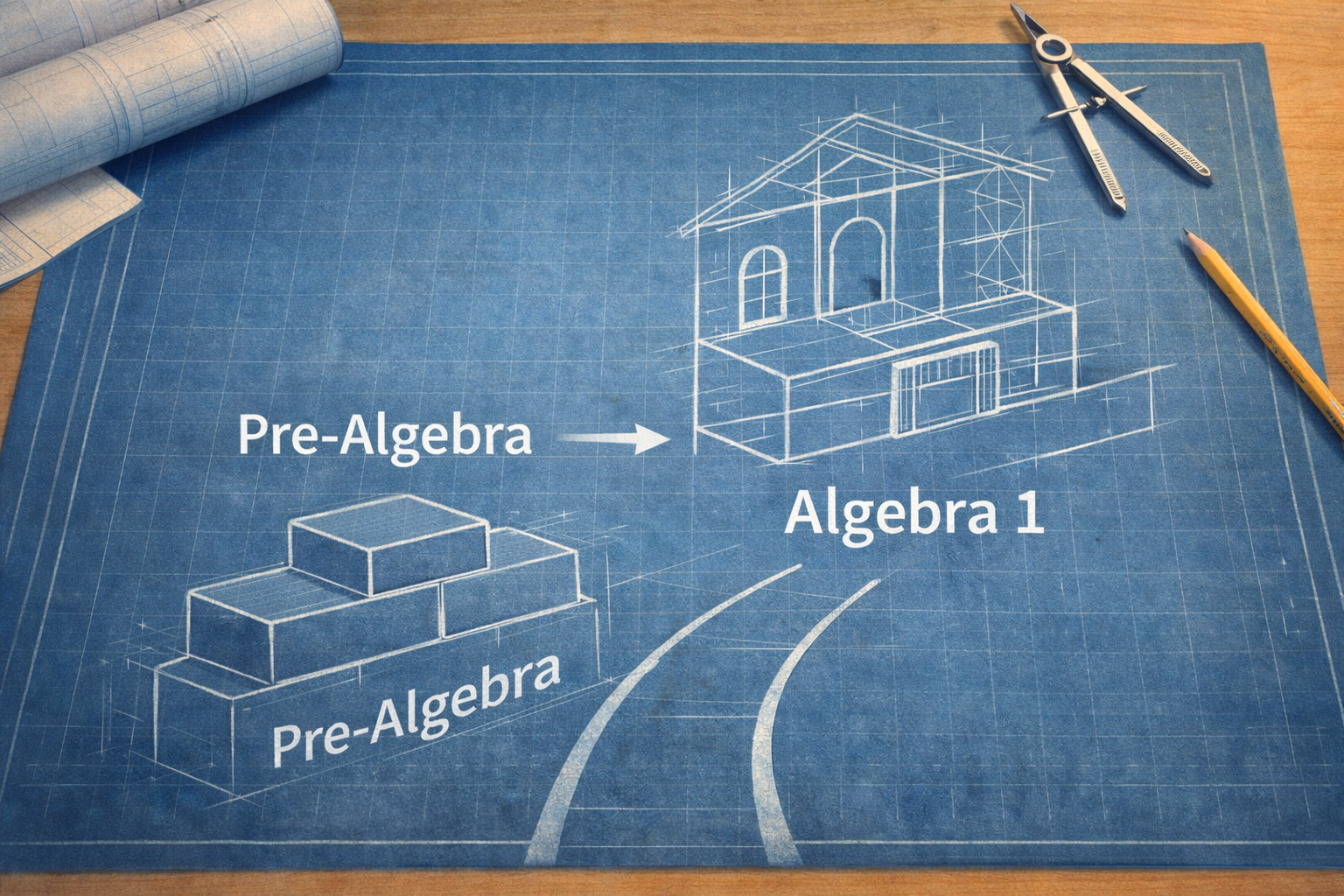
A question that surfaces often in homeschool circles is simple and direct:
“Can we skip Pre-Algebra and go straight into Algebra 1?”
Students ask it.
Parents wrestle with it.
As ninth grade approaches, many homeschoolers realize their public and private school peers are already in Algebra 1. Some began in eighth grade.
That awareness creates pressure.
No family wants to feel behind.
No parent wants to close future doors.
But the real issue is not skipping.
It is readiness.
For most homeschool students, Algebra 1 by ninth grade is appropriate, even if the course takes longer than a traditional school year to complete. The decision should not be driven by comparison or grade labels. It should be grounded in structural stability and long-term planning.
As both a former public school teacher and a homeschool parent of very different learners, I have lived this question personally. In my own home, I have seen students move quickly through math levels with confidence and ease, though even for them there were occasional speed bumps. I have also walked alongside a child who needed additional time to process mathematical thinking. More time. More effort. Careful planning. Sometimes a different technique or approach as the math became more abstract.
Those experiences shaped how I think about placement. Success did not come from speed. It came from intentional pacing and honest evaluation.
There is no universal formula.
Some families worry they are rushing. Others worry they are falling behind. Healthy math pathways are rarely determined by what other students are doing. They are built on consistent observation, thoughtful sequencing, and a willingness to adjust pace without losing direction.
This post is not about pushing students forward prematurely. It is also not about holding capable students back.
It is about understanding what Algebra 1 demands and choosing a path that protects both foundation and forward progress.
II. What Pre-Algebra Actually Protects
If a family is considering skipping a level, I am generally more cautious about skipping Pre-Algebra than skipping a traditional 7th grade math course. If you are wondering how 7th grade math compares with Pre-Algebra and what skills each stage builds, you may find helpful guidance in my earlier post, Can Homeschoolers Skip 7th-Grade Math?
Can Homeschoolers Skip 7th Grade Math? Moving from 6th Grade to Pre-Algebra
Pre-Algebra is not simply a review year. It serves as the structural bridge into algebraic thinking.
This is where students begin working formally with variables. Letters represent unknown quantities, not just placeholders. Verbal statements are translated into symbolic expressions with increasing precision. For example:
“4 less x” translates into 4 − x
“4 less than x” translates into x − 4
“4 is less than x” translates into 4 < x
Those distinctions are not trivial. They require linguistic clarity, symbolic reasoning, and logical structure.
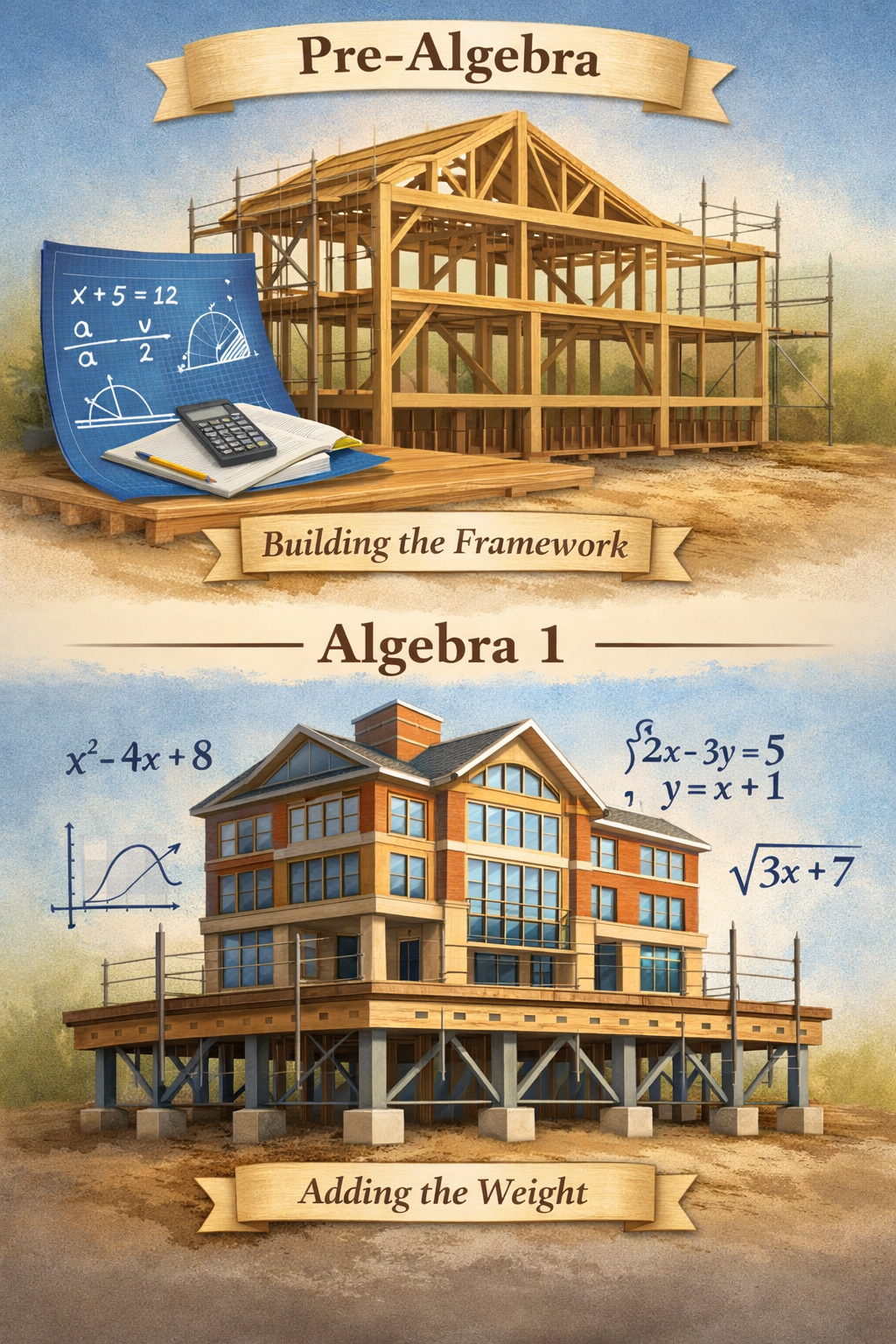
Multi-step equations begin to follow consistent patterns. Ratios and proportional reasoning shift from procedural steps to conceptual relationships.
In many traditional 7th grade math courses, significant time is spent on procedural computation that can be strengthened efficiently alongside later coursework. Pre-Algebra, however, introduces the framework that Algebra 1 will build upon.
If Algebra 1 increases the structural load on a student’s math architecture, Pre-Algebra is where much of that framing is constructed.
This does not always require a full year labeled “Pre-Algebra” before beginning Algebra 1. At the high school level in particular, that framework can continue to be strengthened during Algebra 1, provided the pace allows for reinforcement rather than rushing.
III. What Algebra 1 Actually Demands
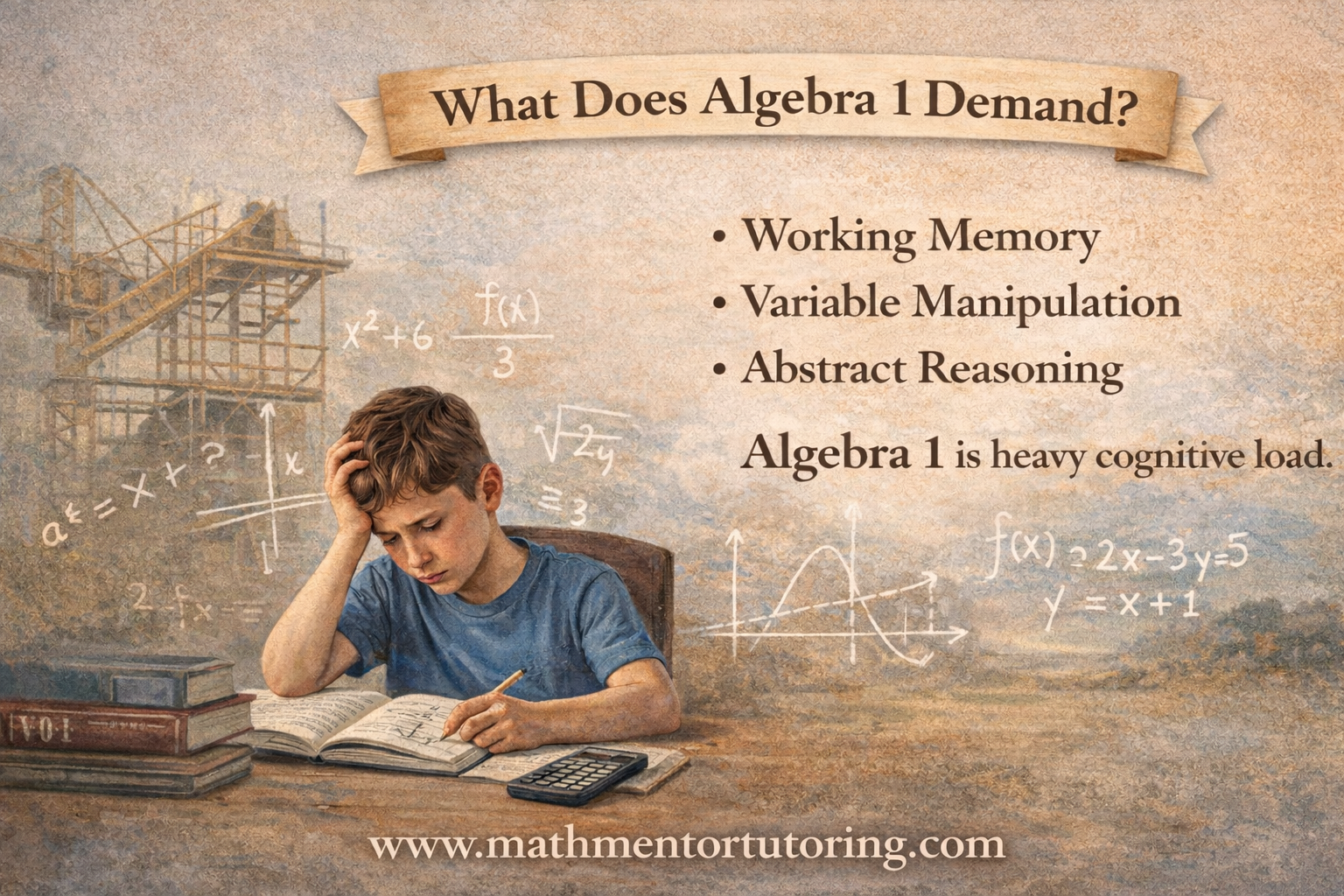
If Pre-Algebra constructs the framing, Algebra 1 increases the structural load on that framework.
The shift into Algebra 1 is not simply about harder numbers. It is about sustained abstraction.
Students are asked to:
• Manipulate variables fluently
• Maintain logical structure across multiple steps
• Translate between equations, graphs, tables, and verbal descriptions
• Hold several ideas in working memory at once
• Apply prior skills without constant re-teaching of foundational procedures
This is where cognitive load becomes visible.
A student who is still devoting significant mental energy to integer rules or fraction computation has fewer cognitive resources available for symbolic reasoning. When basic computation requires heavy effort, abstraction feels overwhelming. In Algebra 1, abstraction means working with symbols that represent ideas rather than concrete numbers. That does not mean the student is incapable of Algebra 1. It means the structural load must be increased carefully.
Some weaknesses are manageable. Inconsistent integer fluency or slower fraction computation can often be strengthened alongside Algebra 1. In fact, many students solidify those skills precisely because they are applying them in more meaningful contexts.
Other weaknesses are structural and affect how a student processes abstraction itself. If a student struggles to understand what an equation represents, cannot sustain multi-step logic, or consistently shuts down when abstraction increases, the framework underneath may need reinforcement before additional load is added.
The goal is not perfection before beginning Algebra 1.
The goal is stability under load.
Architecture does not require flawless materials. It requires materials strong enough to carry increasing weight safely.
IV. High School Placement: Forward Motion with Parallel Repair
By the time students reach ninth grade, something important has changed.
Adolescence brings significant neurological development. Research from the National Institute of Mental Health explains that the brain continues to mature throughout the teenage years, particularly in the prefrontal cortex, which governs planning, working memory, and abstract thinking.¹
This matters for math placement.
A student who struggled with abstraction at twelve may process it very differently at fourteen. Increased developmental maturity often allows students to sustain multi-step reasoning and symbolic manipulation with greater stability.
From my years teaching Algebra 1 in public high schools, I rarely saw students enter perfectly polished. Most arrived with uneven fluency in fractions or integers. What determined their success was not perfection at the starting line. It was whether their reasoning capacity could support growth under increased load, and whether they were willing to engage that growth process consistently.
Students who entered with foundational gaps but worked steadily often saw those deficits shrink as the year progressed. Skills that once felt heavy became lighter with repeated application. Algebra 1 did not just expose weaknesses. It strengthened them when students remained engaged.
For most homeschool students, Algebra 1 by ninth grade is appropriate, even if the course takes a few months longer than a traditional school year to complete.
At the high school level, I do not generally recommend placing a student into a full Pre-Algebra course unless there are significant structural gaps. Most ninth graders have the mental capacity required for Algebra 1. The more common issue is foundational fluency, not cognitive ability.
In those cases, forward motion with parallel reinforcement is often the healthiest approach.
That may mean spending intentional time each week strengthening fraction operations or integer fluency. It may mean extending Algebra 1 beyond a traditional nine-month timeline. But an extended Algebra 1 course that builds both abstraction and fluency is usually more beneficial than a full high school year spent in a course that does not advance the transcript.
Homeschooling allows for this flexibility. You are not tied to an August start date or a rigid nine-month completion window. Algebra 1 can take ten months. It can take fourteen. The goal is not speed. The goal is steady, stable progress.
Intentional sequencing matters, but protecting the student’s growth matters more than protecting a previously mapped plan.
Forward motion does not mean ignoring gaps. It means addressing them while continuing to build.
¹ National Institute of Mental Health. “The Teen Brain: 7 Things to Know.”
https://www.nimh.nih.gov/health/publications/the-teen-brain-7-things-to-know
V. Homeschooling Is Not a 9-Month Contract
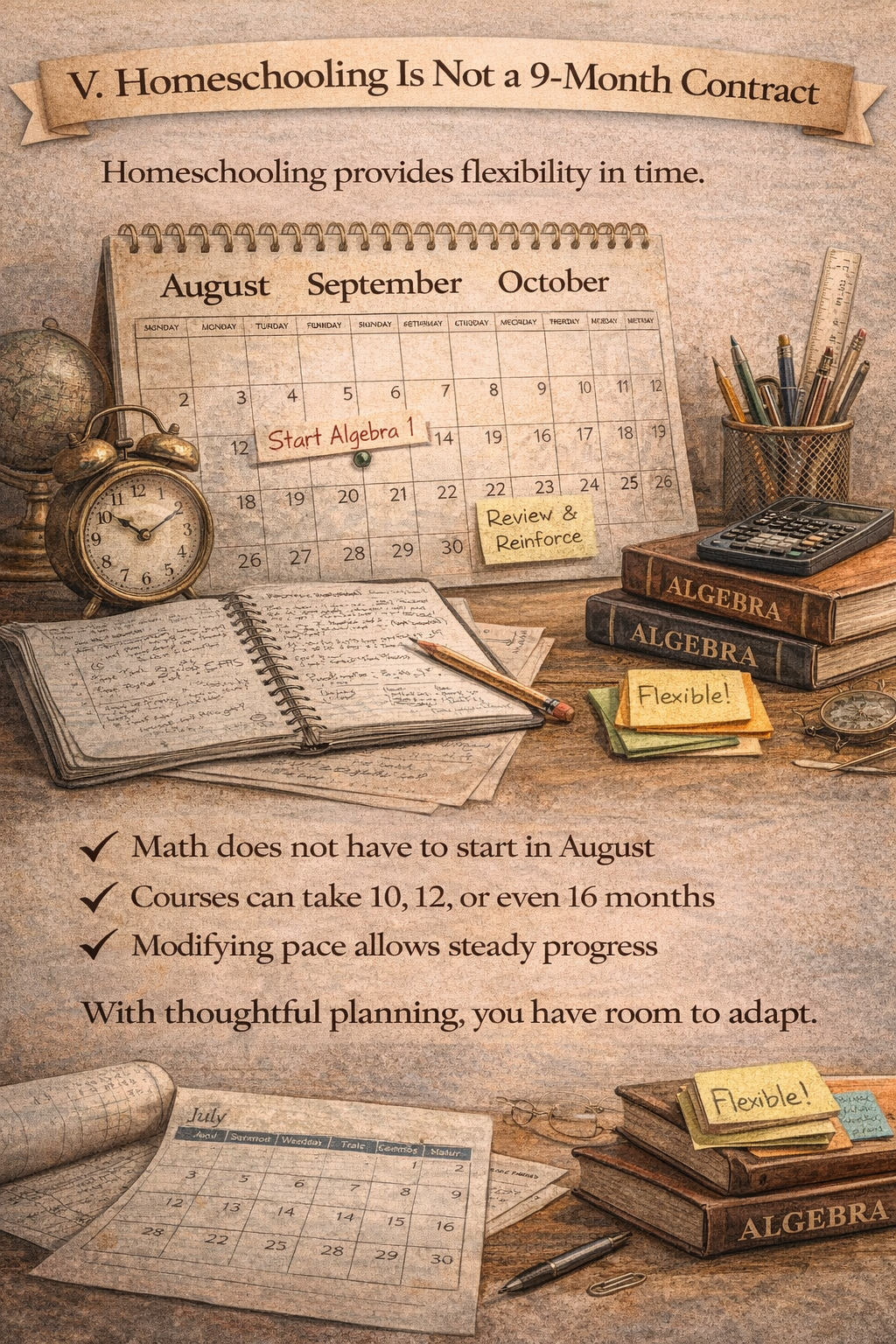
One of the greatest advantages of homeschooling is flexibility in time.
Traditional schools are bound to an academic calendar. Courses begin in August. They end in May. The pacing is largely fixed.
Homeschool families are not bound to that structure.
A math course does not have to begin in August. It does not have to end in nine months. It does not have to align perfectly with a grade label.
Algebra 1 can begin in October. It can extend into summer. It can pause briefly for reinforcement and resume with stronger footing.
What matters is not the calendar.
What matters is whether the student is progressing steadily and gaining stability in reasoning.
As a homeschool parent of very different learners, I have planned math pathways that required extra time at certain levels and quicker movement at others. In our home, the goal was never speed. It was stability and long-term strength.
That often required thinking ahead so there would be flexibility later.
Sometimes that means accelerating. Sometimes that means extending.
It rarely means stopping entirely unless the foundation truly requires reconstruction.
Homeschooling allows you to adjust pace without abandoning direction.
VI. Planning the Next Step: Three Thoughtful Paths
Placement decisions should not be made in reaction to a hard week.
They should be made in light of patterns, supports, and the student’s overall trajectory.
A diagnostic assessment can be extremely helpful here. Not to label a student, but to identify specific gaps. When you know exactly what needs reinforcement, repair becomes targeted and manageable instead of overwhelming.
And there is no need to wait.
Foundation repair can begin now, alongside the current curriculum. Strengthening fractions, integers, proportional reasoning, and equation structure in parallel with present coursework often reduces pressure later.
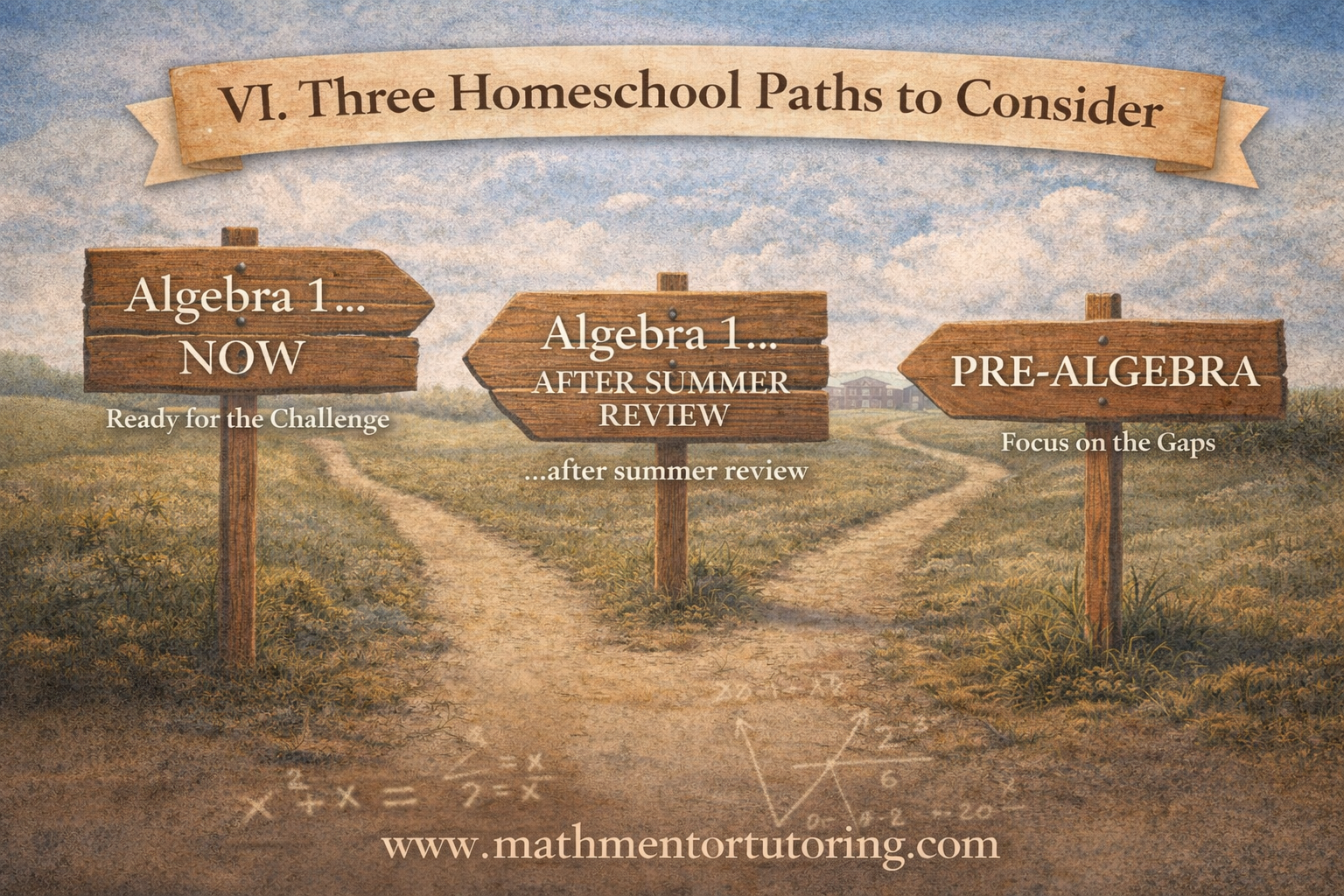
When planning for the next school year, most families will find themselves in one of three paths.
Path A: Start Algebra 1 Next (Standard Pace)
This path makes sense when:
Your student finished Pre-Algebra and generally understood what they were doing.
Fractions and integers are not perfect, but they are workable.
From my years teaching Algebra 1 in public high schools, I rarely saw students enter perfectly prepared. Many had uneven skills in fractions or integers and still succeeded. With consistent instruction and steady effort, those gaps often shrank as the school year progressed.
Today’s Algebra 1 programs often include built-in teaching through video lessons and guided examples. Parents do not have to be algebra experts for students to succeed, especially when students are willing to engage and try.
If your student can handle new material without shutting down and has a foundation that is “strong enough,” starting Algebra 1 at a normal pace is often appropriate.
Path B: Start Algebra 1 Next (Extended Pace + Parallel Repair)
This path makes sense when:
Your student is entering high school and has not yet completed Pre-Algebra.
They understand basic algebra ideas but still struggle with fractions, integers, or other basics.
They can think abstractly, but computation sometimes slows them down.
They need more repetition for skills to feel automatic.
In this case, you do not have to wait another full year before beginning Algebra 1.
Instead, begin strengthening those foundational skills now. Identify specific gaps through a diagnostic assessment and start working on them in small, focused ways in parallel with the current math course.
Continue that reinforcement over the summer so your student begins Algebra 1 more prepared.
Summer repair does not have to mean long, rigorous lessons. Focused thirty-minute to one hour sessions a few days each week can preserve skills and gradually close gaps without taking over your family’s rhythm.
Then begin Algebra 1 next year with an extended timeline if needed.
An Algebra 1 course that takes a little longer while skills are strengthened in parallel is often more beneficial than spending an entire high school year in a course that does not advance the transcript.
Forward motion with reinforcement protects both confidence and long-term progress.
Path C: Build a Strategic Bridge First
This path may be appropriate when:
Your student becomes confused quickly when letters replace numbers.
Multi-step problems consistently fall apart after the first or second step.
Even with explanation and guidance, the process does not seem to stick.
Small mistakes compound and lead to frustration or shutdown.
You find yourself re-teaching the same foundational ideas without lasting progress.
In these cases, a Pre-Algebra course may be the wisest next step, even at the high school level.
This is not a failure.
It is not off the table.
It is not permanent.
For some learners, a carefully structured Pre-Algebra year provides the stability required for long-term success in Algebra 1 and beyond.
The key is intentional sequencing, not stigma.
Before You Decide
Ask yourself:
Have we identified areas of weakness clearly through a diagnostic assessment?
Have I put a plan in motion for addressing those areas now? (Why wait?)
What support will realistically be available next year?
Is our chosen curriculum flexible, or does it move at a fixed pace?
Am I protecting long-term growth, or reacting to short-term frustration?
Most ninth graders are capable of Algebra 1 reasoning.
Not all are ready in the same way or under the same conditions.
Protect the student.
Protect the architecture.
Then choose the path that allows steady, sustainable growth.
Conclusion: Protect the Student
Algebra 1 is not a race.
Pre-Algebra is not a badge.
Grade level is not the ultimate decision-maker.
Architecture matters.
Pacing matters.
Support matters.
Effort matters.
For many homeschool families, Algebra 1 by ninth grade is appropriate, even if it takes longer than a traditional school year to complete. For others, a carefully planned bridge provides the stability needed for long-term success.
There is no universal formula.
There is thoughtful planning.
There is honest evaluation.
There is steady forward movement.
Protect the student.
Protect the architecture.
And choose the next step that supports sustainable growth.
If you are still unsure which path fits your child best, a diagnostic assessment combined with a placement conversation can bring clarity. Together we can identify specific gaps, determine readiness, and build a math plan that supports both confidence and long-term opportunity.
You do not have to guess.
Contact me for a FREE Consultation
If you are navigating the earlier decision between 7th grade math and Pre-Algebra, you may also find helpful context in Can Homeschoolers Skip 7th-Grade Math?
Can Homeschoolers Skip 7th Grade Math? Moving from 6th Grade to Pre-Algebra
And if you are thinking ahead to how Algebra 1 fits into high school sequencing and future dual enrollment options, that conversation naturally follows from this one.
Intentional planning today protects opportunity tomorrow.
About the Author

Beth Bowen is the founder of Math Mentor Tutoring, where she works with middle school and high school students to build strong mathematical foundations and confident reasoning. A former public high school math teacher and longtime homeschool parent, she brings both classroom experience and personal insight to math placement decisions.
Beth specializes in Algebra readiness, strategic sequencing, and targeted foundation repair. She is passionate about reducing test anxiety, equipping students with practical learning tools, and helping families build math confidence that lasts beyond a single course or exam.
She believes that lack of knowledge does not mean lack of intelligence, and that with the right structure and support, students can grow into confident, capable math thinkers.


